

Short answer: a dedicated server in the Netherlands suits websites and services whose users are in Western Europe and the UK. Between data centres, round trips from the Netherlands to Brussels, London, Frankfurt and Paris take around 8 to 13 ms, and every European region in Microsoft’s published statistics is within 30 ms. Hosting in the Netherlands also keeps stored personal data inside the EU, which simplifies one part of GDPR, although GDPR applies because of whose data you handle, not only where the server is. Check the hardware, bandwidth terms, remote console, support and backups before you order.
Why the Netherlands is a popular place for European servers
Two reasons: position and connectivity. The Netherlands sits close to the UK, Germany, France and Scandinavia, and Amsterdam has a long history as a meeting point for networks. According to AMS-IX, the Amsterdam Internet Exchange, Amsterdam has long been recognised as one of the world’s most important internet hubs, a place where hundreds of networks choose to interconnect. An internet exchange is where networks connect to each other directly to swap traffic.
Microsoft’s published round-trip statistics between its data-centre regions show what that position means in practice:
| From the Netherlands to | Median round trip |
|---|---|
| Brussels, Belgium | 8 ms |
| London, UK | 11 ms |
| Frankfurt, Germany | 11 ms |
| Paris, France | 13 ms |
| Copenhagen, Denmark | 15 ms |
| Ireland | 17 ms |
| Zurich, Switzerland | 17 ms |
| Milan, Italy | 22 ms |
| Warsaw, Poland | 23 ms |
| Madrid, Spain | 27 ms |
| Virginia, USA | 85 ms |
| Dubai, UAE | 111 ms |
| Pune, India | 140 ms |
| Singapore | 169 ms |
For a European audience, that means one server in the Netherlands can serve most of the continent well. For users in the Americas or Asia, a second server closer to them will do better than any single European location.
GDPR: what hosting in the Netherlands does and does not do
This section is general information, not legal advice.
- It keeps the data in the EEA. According to the European Commission, EU data protection rules cover the European Economic Area (the EU plus Iceland, Liechtenstein and Norway), and personal data transferred outside it needs extra safeguards, such as an adequacy decision or standard contractual clauses. A server in the Netherlands stores data inside the EEA, so storing it there is not an international transfer.
- It does not decide whether GDPR applies to you. The Commission explains that GDPR applies to organisations with an establishment in the EU, regardless of where the data is processed, and to organisations outside the EU that offer goods or services to, or monitor the behaviour of, people in the EU. A company outside Europe serving EU customers is covered wherever its server is.
- Your host is usually a processor. The Commission notes that a processor’s duties towards the controller must be set out in a contract. Ask your provider how it handles that.
- Backups count too. If the live server is in the Netherlands but your backups go to storage outside the EEA, the backups are the transfer. Keep them in the EEA, or put the right safeguards in place.
What people run on a Netherlands dedicated server
- Websites, shops and SaaS platforms for customers across Europe and the UK.
- Streaming and radio servers, and origin servers that feed a content delivery network.
- VPN and proxy endpoints for European users.
- Backup servers that keep an off-site copy of European data inside the EU.
What to check before you order
| Check | What to ask |
|---|---|
| Hardware | CPU model and generation, ECC memory, SSD or hard disks, RAID |
| Bandwidth | Monthly transfer allowance and port speed; what happens if you go over |
| IP addresses | How many IPv4 addresses are included; reverse DNS for mail servers |
| Remote console | IPMI or KVM access for when the operating system will not boot |
| Data protection | A contract that covers the provider’s role as a processor |
| Backups | Who takes them, and where they are stored |
| Delivery and hardware failure | How long delivery takes, and how quickly failed parts are replaced |
| Support | What is included for free, and what extra work costs |
A quick way to judge a monthly transfer allowance is to turn it into an average speed. A 30-day month has 2,592,000 seconds, so 10 TB a month works out at about 31 Mbps around the clock, and 100 TB at about 309 Mbps. If your traffic is far below the allowance, you have room for peaks; if it is close, look at a bigger allowance or a faster port.
Test the route from your users
Published figures are a guide. Before you commit, ask for a test IP address and measure from where your users are:
mtr -r -w -c 20 203.0.113.10Replace the example address with the test IP. The report shows each hop, with the loss and the average, best and worst round trip, so you can see where delay starts. Our MTR guide explains the columns, and iperf3 helps if you also want to measure throughput between two servers.
Netherlands dedicated servers at Ucartz
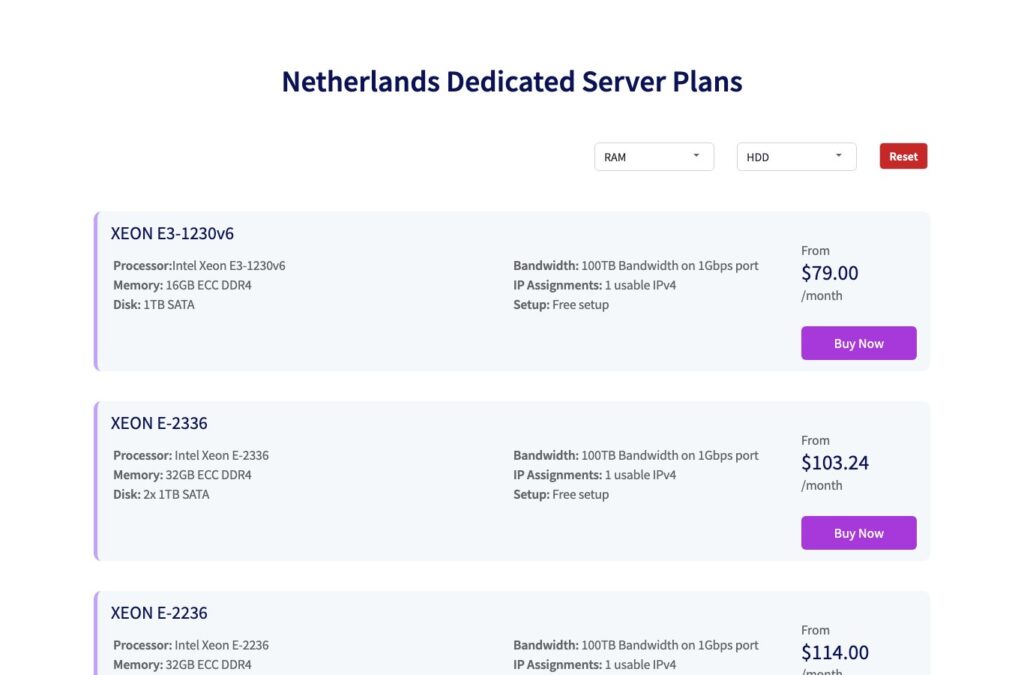
Our Netherlands dedicated servers are self-managed Intel Xeon machines with full root access. Each plan lists its processor, memory, disks, monthly bandwidth, port speed and IPv4 addresses, so you can check it against the list above. Every server includes Free Basic Managed Support for quick tasks such as boot and access checks, OS reinstalls and DNS pointing, and you can hire our engineers per task or per hour for hardening, migrations or RAID work. Failed hardware is repaired or replaced within 24 hours of confirming the fault, as set out in our service level agreement. Backups on self-managed servers are your responsibility, and dedicated servers are not covered by the 30-day money-back guarantee, so start on monthly billing if you want to test first.