
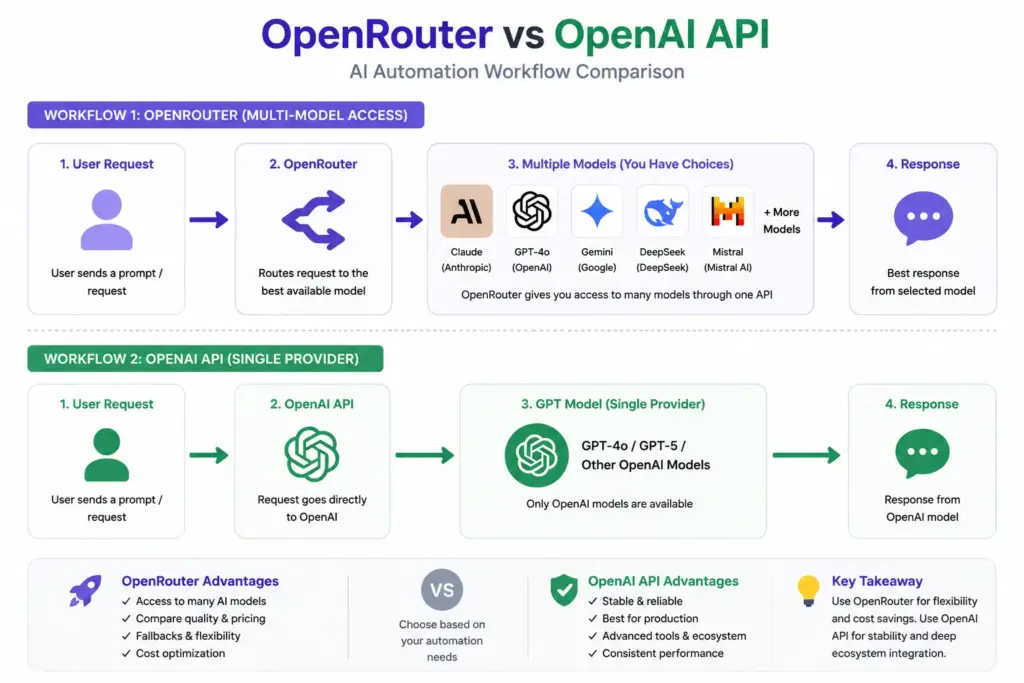
OpenRouter is better for AI automation when you need model flexibility and cost control; OpenAI API is better when you need the highest quality output from a single trusted provider. OpenAI API platform gives you direct access to OpenAI’s model family GPT-4o, GPT-4o-mini, o1, o3, and their variants. You create an account, add billing, get an API key, and call OpenAI’s endpoints. Every request goes to OpenAI’s infrastructure. Every dollar you spend goes to OpenAI.
OpenRouter unified interface is a routing layer that sits in front of dozens of AI providers. You create one OpenRouter account, get one API key, and use one endpoint format to access models from OpenAI, Anthropic, Google, Mistral, Meta, Cohere, and hundreds of open-source models hosted by third parties. OpenRouter handles provider authentication, billing consolidation, and automatic failover between providers.
Both platforms use the same API format. A request you write for OpenAI works on OpenRouter with one URL change and the same JSON structure. This makes switching between them straightforward at the code level.
Pricing
OpenAI charges you their listed rate for every model. GPT-4o costs $2.50 per million input tokens and $10 per million output tokens as of mid-2026. GPT-4o-mini costs $0.15 per million input tokens and $0.60 per million output tokens.
OpenRouter charges you the provider’s rate plus a small routing margin, but it also gives you access to models that cost a fraction of GPT-4o-mini. Some models on OpenRouter cost $0.01 per million tokens or less. For automation workflows that run thousands of requests per day, this difference compounds into significant monthly savings.
Concrete comparison for an n8n automation that processes 100,000 requests per month with an average of 500 tokens per request (50 million tokens total):
| Model | Platform | Monthly Cost |
|---|---|---|
| GPT-4o | OpenAI | $625+ |
| GPT-4o-mini | OpenAI | $37.50 |
| GPT-4o-mini | OpenRouter | ~$40 (with margin) |
| Mistral 7B Instruct | OpenRouter | ~$3.50 |
| Llama 3.1 8B | OpenRouter | ~$0.50 |
| Gemini Flash 1.5 | OpenRouter | ~$3.75 |
For automation tasks where the cheapest capable model does the job, OpenRouter gives you access to models that cost 50-100x less than GPT-4o while delivering acceptable quality for structured tasks like classification, extraction, and summarization.
API Compatibility
This is the most practical point for developers building automation. Both platforms accept the same request structure:
OpenAI direct call:
import openai

client = openai.OpenAI(api_key="YOUR_OPENAI_KEY")

response = client.chat.completions.create(
    model="gpt-4o-mini",
    messages=[
        {"role": "system", "content": "You are a support ticket classifier."},
        {"role": "user", "content": "My server has been down for 2 hours."}
    ],
    temperature=0.1
)

print(response.choices[0].message.content)
OpenRouter call with the same client:
import openai

client = openai.OpenAI(
    api_key="YOUR_OPENROUTER_KEY",
    base_url="https://openrouter.ai/api/v1"
)

response = client.chat.completions.create(
    model="openai/gpt-4o-mini",  # same model, prefixed with provider
    messages=[
        {"role": "system", "content": "You are a support ticket classifier."},
        {"role": "user", "content": "My server has been down for 2 hours."}
    ],
    temperature=0.1
)

print(response.choices[0].message.content)
The only differences are the base URL, the API key, and the model string format (OpenRouter prefixes models with their provider name). Your existing OpenAI code works on OpenRouter with three line changes.
Model Selection
OpenAI gives you OpenAI models. GPT-4o, GPT-4o-mini, o1, o3, and the older GPT-3.5 and GPT-4 variants. All high quality. All from one provider. All at OpenAI’s pricing.
OpenRouter gives you access to the following model families through one account:
OpenAI:     GPT-4o, GPT-4o-mini, o1, o3
Anthropic:  Claude Opus 4, Sonnet 4, Haiku
Google:     Gemini 2.5 Pro, Flash, Flash-Lite
Meta:       Llama 3.1 8B, 70B, 405B
Mistral:    Mistral 7B, Mixtral 8x7B, Large
Cohere:     Command R, Command R+
Qwen:       Qwen2.5 7B, 72B
DeepSeek:   DeepSeek V3, R1
For automation workflows, this range lets you match the model to the task instead of defaulting to one provider for everything. Use a cheap fast model for classification. Use a mid-tier model for summarization. Use GPT-4o or Claude Sonnet only for tasks that genuinely require top-tier reasoning. OpenRouter makes this task-to-model matching easy from a single account.
Reliability and Failover
OpenAI API has a direct dependency: if OpenAI experiences an outage, your automation stops. OpenAI’s uptime is generally high, but incidents do happen and they affect every workflow that depends on a single provider.
OpenRouter adds a failover layer. You configure fallback models and OpenRouter automatically routes to the fallback if the primary provider is unavailable or too slow.
Configure fallback in OpenRouter:
response = client.chat.completions.create(
    model="openai/gpt-4o-mini",
    messages=[
        {"role": "user", "content": "Classify this support ticket: server unreachable"}
    ],
    extra_body={
        "route": "fallback",
        "models": [
            "openai/gpt-4o-mini",
            "anthropic/claude-haiku-20240307",
            "mistralai/mistral-7b-instruct"
        ]
    }
)
OpenRouter tries the first model. If it fails or times out, it automatically tries the second, then the third. Your automation continues running even during provider outages. This is not possible with a direct OpenAI API integration without writing your own fallback logic.
Rate Limits
OpenAI rate limits depend on your account tier. New accounts start on Tier 1 with 500 requests per minute on GPT-4o-mini. Higher tiers require spending history. If your automation hits a rate limit, requests return a 429 error and you need retry logic.
OpenRouter distributes requests across multiple provider accounts, which means effective rate limits are higher for popular models. For high-volume automation workflows, OpenRouter’s distributed routing reduces the frequency of rate limit errors without requiring you to manage multiple provider accounts yourself.
In n8n, handle rate limits from either platform with a Wait node and retry logic after a 429 response:
// In a Code node after HTTP Request
const statusCode = $json.error?.status || $json.statusCode;

if (statusCode === 429) {
  return [{
    json: {
      retry: true,
      wait_seconds: 10,
      original_prompt: $json.prompt
    }
  }];
}

return [{ json: { retry: false, response: $json.choices[0].message.content } }];
Using Both in n8n Automation Workflows
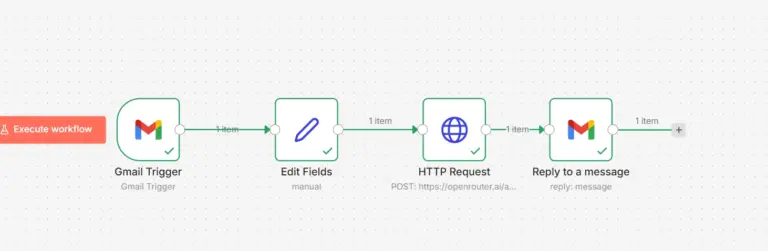
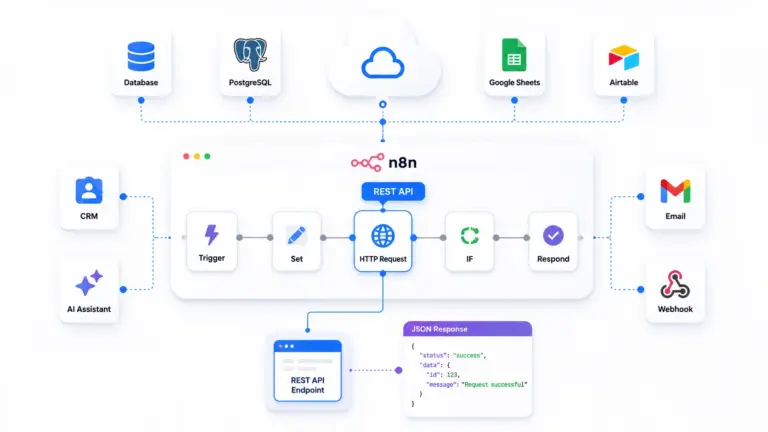
In n8n, the HTTP Request node calls either platform with minimal configuration difference.
OpenAI direct in n8n:
{
  "method": "POST",
  "url": "https://api.openai.com/v1/chat/completions",
  "headers": {
    "Authorization": "Bearer YOUR_OPENAI_KEY",
    "Content-Type": "application/json"
  },
  "body": {
    "model": "gpt-4o-mini",
    "messages": [
      {
        "role": "system",
        "content": "You are a lead qualification assistant. Return JSON only."
      },
      {
        "role": "user",
        "content": "{{$json.lead_description}}"
      }
    ],
    "temperature": 0.1
  }
}
OpenRouter in n8n (swap two values):
{
  "method": "POST",
  "url": "https://openrouter.ai/api/v1/chat/completions",
  "headers": {
    "Authorization": "Bearer YOUR_OPENROUTER_KEY",
    "Content-Type": "application/json",
    "HTTP-Referer": "https://yourdomain.com",
    "X-Title": "Lead Qualification Bot"
  },
  "body": {
    "model": "mistralai/mistral-7b-instruct",
    "messages": [
      {
        "role": "system",
        "content": "You are a lead qualification assistant. Return JSON only."
      },
      {
        "role": "user",
        "content": "{{$json.lead_description}}"
      }
    ],
    "temperature": 0.1
  }
}
The HTTP-Referer and X-Title headers are optional but recommended for OpenRouter. They help OpenRouter attribute usage correctly and may affect routing priority.
To switch from GPT-4o-mini to Mistral 7B in this workflow, you change one value: the model string. Everything else stays identical.
Quality Comparison for Automation Tasks
For tasks common in automation workflows, here is how model quality compares across the two platforms:
Structured JSON output – GPT-4o-mini and Claude Haiku produce the most consistent JSON. Mistral 7B and Llama 3.1 8B produce valid JSON roughly 85-90% of the time with a strict system prompt. For automation that breaks on malformed JSON, GPT-4o-mini via either platform is the safer choice.
Text classification – Any model in the 7B parameter range handles binary and categorical classification accurately with a clear system prompt. Mistral 7B via OpenRouter at $0.07 per million tokens produces classification quality comparable to GPT-4o-mini at $0.15 per million tokens for most practical use cases.
Summarization – Larger models summarize better. Claude Sonnet and GPT-4o produce noticeably better summaries than 7B models on long complex documents. For short documents under 500 words, 7B models via OpenRouter are comparable and significantly cheaper.
Instruction following – GPT-4o and Claude Sonnet follow complex multi-step instructions more reliably than smaller models. For automation tasks with simple, clear instructions, smaller models handle them correctly. For tasks with nuanced conditional logic in the prompt, use a larger model.
When to Use OpenAI API Directly
Use the OpenAI API directly when:
You need the highest output quality available and cost is secondary to results. Your automation handles complex reasoning, multi-step logic, or tasks where errors have significant consequences. You want a single vendor relationship with direct support. Your team is standardized on OpenAI tooling and switching cost outweighs routing flexibility. You use OpenAI-specific features like Assistants API, fine-tuning, or structured outputs with response format enforcement.
When to Use OpenRouter
Use OpenRouter when:
You run high-volume automation where token costs compound significantly. Your workflow can route different task types to different models based on complexity. You need provider failover without building your own redundancy layer. You want to test multiple models against your specific task without managing multiple API accounts. You use models from Anthropic, Google, or Meta alongside OpenAI and prefer one unified billing account. You are building on a Ucartz VPS hosting and want to keep infrastructure costs predictable by choosing the cheapest capable model per task.
The Practical Setup
The most effective production approach uses both platforms with task-based routing.
def get_ai_client(task_type):
    if task_type in ["complex_reasoning", "code_review", "legal_analysis"]:
        # High-stakes tasks go to GPT-4o via OpenAI directly
        return openai.OpenAI(
            api_key=OPENAI_KEY
        ), "gpt-4o"

    elif task_type in ["classification", "extraction", "summarization"]:
        # Standard tasks go to Mistral via OpenRouter at lower cost
        return openai.OpenAI(
            api_key=OPENROUTER_KEY,
            base_url="https://openrouter.ai/api/v1"
        ), "mistralai/mistral-7b-instruct"

    else:
        # Default to GPT-4o-mini via OpenRouter for fallback coverage
        return openai.OpenAI(
            api_key=OPENROUTER_KEY,
            base_url="https://openrouter.ai/api/v1"
        ), "openai/gpt-4o-mini"

def run_inference(task_type, system_prompt, user_prompt):
    client, model = get_ai_client(task_type)

    response = client.chat.completions.create(
        model=model,
        messages=[
            {"role": "system", "content": system_prompt},
            {"role": "user", "content": user_prompt}
        ],
        temperature=0.1
    )

    return response.choices[0].message.content
This router sends complex, high-stakes tasks to GPT-4o where quality matters most and routes high-volume standard tasks to cheaper models via OpenRouter. You get the best quality where it counts and the lowest cost where it does not.
Cost Projection for a Typical Automation Stack
A Ucartz VPS Pro at $30/month running n8n with these workflows:
Daily lead qualification: 500 leads at 300 tokens each = 150,000 tokens/day = 4.5M tokens/month Support ticket triage: 1,000 tickets at 200 tokens each = 200,000 tokens/day = 6M tokens/month Weekly report generation: 50 reports at 1,000 tokens each = 50,000 tokens/month
Total: approximately 10.5 million tokens per month.
| Platform and Model | Monthly Token Cost |
|---|---|
| GPT-4o (OpenAI) | $87.50+ |
| GPT-4o-mini (OpenAI) | $7.88 |
| GPT-4o-mini (OpenRouter) | ~$8.50 |
| Mistral 7B (OpenRouter) | ~$0.74 |
| Llama 3.1 8B (OpenRouter) | ~$0.11 |
For a workflow where Mistral 7B or Llama 3.1 8B produces acceptable quality output, the token cost drops from $87.50 to under $1 per month. The VPS at $30/month becomes the dominant cost, not the AI API.
The right answer for most automation builders is OpenRouter for volume tasks and OpenAI directly for quality-critical tasks. Start with OpenRouter, benchmark output quality against your requirements, and escalate to OpenAI only for the tasks where smaller models fall short.
Conclusion
Both the OpenRouter and OpenAI APIs are powerful for AI automation, but they solve different problems.If your priority is:
- access to multiple AI models,
- lower costs,
- flexibility,
- and experimenting with different providers,
then OpenRouter is often the better choice for developers building AI agents, automation workflows, and VPS-hosted applications.
If your priority is:
- maximum reliability,
- enterprise-grade tooling,
- stable model behavior,
- and deep ecosystem integration, then OpenAI API remains one of the strongest choices.
For most automation builders in 2026:
- OpenRouter is ideal for testing, scaling affordably, and switching between models.
- OpenAI API is ideal for production systems where consistency matters more than provider flexibility.
FAQ
What is OpenRouter?
OpenRouter is a unified API platform that gives developers access to multiple AI providers and models through one endpoint.
What is the OpenAI API?
The OpenAI API provides direct access to OpenAI models like GPT-4o, GPT-5, embeddings, and image generation tools.
Which is cheaper: OpenRouter or OpenAI?
OpenRouter is often cheaper because it allows you to choose lower-cost models from multiple providers instead of relying on a single premium model provider.
Is OpenRouter good for AI agents?
Yes. OpenRouter is popular for AI agents because developers can dynamically switch models depending on task complexity and cost.
Which is better for production apps?
OpenAI API is generally better for stable enterprise production environments where predictable performance is critical.
Can I use OpenRouter with Nanobot or n8n?
Yes. OpenRouter works well with automation tools like Nanobot, n8n, LangChain, Flowise, AutoGen & custom Python AI agents
Does OpenRouter support OpenAI models?
Yes. OpenRouter can route requests to OpenAI models alongside models from Anthropic, Google, DeepSeek, Mistral, and others.
Why are developers moving to OpenRouter?
Main reasons lower costs,access to many models, failover flexibility, reduced vendor lock-in & easier experimentation.