

In January 2025, Christian Bautista, Operations Director at Lumora Living, opened a spreadsheet titled “Expansion Capacity Planning” and stared at a blank cell he could not fill in.
The brand, a home decor and lifestyle label out of Dubai, had spent three years building something that worked. Marketing was converting. Customers were coming back. Reviews were strong. The UAE market, 82,000 monthly visitors and 4,800 monthly orders, felt solved.
Then leadership greenlit expansion into three new markets at once: Philippines, the United Kingdom, and Saudi Arabia. The opportunity was real. The infrastructure question underneath it was not something anyone on the team had faced before.
The questions kept multiplying. What if the UK launch outperformed every forecast? Will Philippines sent ten times the expected traffic in week one? What if Saudi Arabia underperformed and the team had already overbuilt for it? What if all three markets behaved nothing like the UAE had?
Nobody on the team could answer with confidence. That uncertainty, not the traffic itself, became the real obstacle.
About Lumora Living
Founded in Dubai, Lumora Living is a direct-to-consumer home décor and lifestyle brand offering furniture, decorative accessories, lighting solutions, and curated home collections.
Prior to expansion, the company operated primarily within the UAE market and had built a reputation for modern, design-focused products aimed at urban households.
Before expansion, Lumora’s infrastructure had been sized for a single, predictable market. The numbers were healthy but narrow:
- Headquarters: Dubai, UAE
- Markets Served: UAE
- 82,000 monthly visitors, almost entirely from inside the UAE
- 4,800 monthly orders
- 2,700 average daily visitors
- 190 peak concurrent users at the highest traffic moments
- 2,300 SKUs across the home decor catalog
- 3.8 second average page load time
- 2.4% checkout completion rate
The business fundamentals were healthy.
The challenge was preparing for growth nobody could accurately predict. None of these numbers were alarming on their own. The problem was what came next.
Why Traditional Capacity Planning Failed
Most infrastructure decisions begin with traffic estimates. Lumora’s leadership team discovered that their problem was far more complicated.
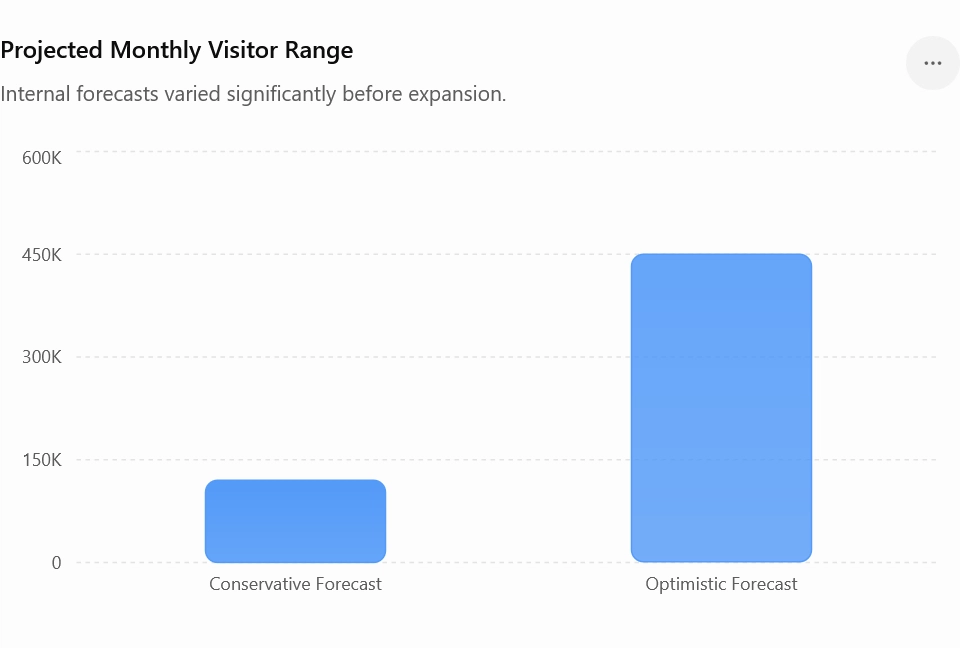
Internal forecasts ranged from approximately 120,000 monthly visitors on the conservative end to more than 450,000 monthly visitors on the optimistic end.
A forecast range that wide made traditional infrastructure planning difficult. Every option involved risk.
Option 1: Build for Maximum Demand
Advantages
- Significant capacity headroom
- Reduced risk of traffic-related outages
Challenges
- Large upfront investment
- Potentially significant unused resources
- Reduced efficiency if demand grew slower than expected
Option 2: Build for Current Demand
Advantages
- Lower initial costs
- Faster deployment
Challenges
- Increased risk during launch periods
- Limited flexibility
- Potential performance issues if growth exceeded forecasts
Option 3: Cloud Infrastructure That Scales On Demand
Advantages
- Flexible resource allocation
- Ability to respond to actual demand
- Reduced forecasting risk
- Faster expansion readiness
Once the team reframed the challenge as uncertainty rather than traffic, the decision became much clearer. They did not need the largest infrastructure. They needed the most adaptable one.
Why Lumora Chose Ucartz Cloud Hosting
During evaluation, the team reviewed several hosting and infrastructure options.
Cloud computing infrastructure was selected based on five factors that directly aligned with the expansion strategy:
1. On-Demand Scalability
Resources could be adjusted based on actual customer demand instead of projected forecasts.
2. Multi-Region Readiness
The infrastructure was capable of supporting visitors across multiple countries without requiring separate deployments for every market.
3. Managed Migration Support
The company wanted to minimize risk to existing UAE operations while preparing for expansion.
4. Operational Visibility
Real-time monitoring and performance insights would help identify market-specific trends and issues quickly.
5. Cost Efficiency
The ability to scale gradually reduced the risk of overinvesting in infrastructure before demand materialized.
The Migration to Ucartz Cloud Hosting
Lumora migrated its e-commerce platform to Ucartz Cloud Hosting before launching in any of the three new markets. The objective was never simply better page speed. It was building infrastructure that could absorb whatever the next six months actually looked like, rather than whatever a spreadsheet had predicted.
The migration covered:
- Full website infrastructure migration onto Ucartz Cloud Hosting
- Database optimization to handle a catalog that was about to grow significantly
- Automated backup implementation across all environments
- Performance monitoring setup with market-level visibility
- Expansion readiness testing, simulating multi-region traffic before any real customer saw the new setup
The full migration took four weeks. No major customer-facing disruption occurred during the transition, a detail the team had flagged as non-negotiable given that UAE orders could not be put at risk while preparing for markets that didn’t exist yet.
Challenges During Migration
Like most infrastructure projects, the migration was not without obstacles.
The team encountered several challenges:
Catalog Optimization
Years of catalog growth had created opportunities for database cleanup and optimization before expansion.
Traffic Simulation
Because international traffic patterns were unknown, multiple testing scenarios were required to simulate launch-day conditions.
Operational Continuity
The UAE business could not experience downtime while the migration was underway.
Market Readiness Validation
The team needed confidence that infrastructure could support customers across multiple regions before launch.
What Actually Happened After Launch
Month 1
The United Kingdom outperformed every forecast on the table, with traffic increasing 48% above projections in the first 30 days. Philippines contributed steady but modest early growth. Saudi Arabia, the market nobody had been confident about, immediately showed the strongest average order values across the entire portfolio.
Month 3
Growth had stopped being gradual and started compounding. Monthly visitors reached 147,000. Monthly orders hit 8,900. The brand was now serving four countries, including UAE, with peak concurrent users climbing to 520, nearly three times the pre-expansion ceiling. The infrastructure did not require a single emergency intervention through any of it.
Month 6
Six months in, Lumora crossed several thresholds the team had genuinely not expected to hit this early.
Results After Six Months
| Metric | Before Expansion | After 6 Months | Change |
| Monthly visitors | 82,000 | 278,000 | +239% |
| Monthly orders | 4,800 | 15,600 | +225% |
| Countries served | 1 | 4 | +3 markets |
| International revenue share | 7% | 42% | +35pp |
| Average page load time | 3.8 sec | 1.9 sec | -50% |
| Checkout completion rate | 2.4% | 3.7% | +54% |
| Peak concurrent users supported | 190 | 520 | +174% |
| Average order value (UAE baseline) | AED 312 | AED 367 | +18% |
| Cart abandonment rate | 71% | 58% | -13pp |
| Infrastructure incidents | 11 / quarter | 2 / quarter | -82% |
| IT planning hours | 18 / month | 5 / month | -72% |
| Mobile conversion rate | 1.6% | 3.1% | +94% |
| Product catalog size | 2,300 SKUs | 3,950 SKUs | +72% |
| Repeat customer rate (90-day) | 19% | 31% | +12pp |
| Server response time under launch spike | 6.4 sec | 1.1 sec | -83% |
| Time to provision new market capacity | 6 to 8 weeks | Under 48 hours | Near-instant |
How Each Market Actually Performed
| Market | Monthly Visitors | Avg. Order Value | Conversion Rate | Notes |
| UAE (home market) | 127,000 | AED 367 | 1.1% | Steady, mature |
| United Kingdom | 61,000 | AED 412 | 2.0% | +48% vs. forecast |
| Philippines | 73,500 | AED 198 | 1.4% | Slower start, steady climb |
| Saudi Arabia | 16,500 | AED 489 | 0.9% | Highest AOV market |
Saudi Arabia, the market everyone had been least confident about, ended up delivering the highest average order value of any region, UAE included. Philippines started slower than projected but climbed steadily month over month as word of mouth and repeat purchases built momentum. None of this matched the original forecast spreadsheet. The infrastructure did not need it to.
The Meeting That Stopped Being About Servers
Six months after migration, leadership noticed something unexpected.
Weekly meetings that previously focused on infrastructure concerns were now entirely focused on products, marketing, supply chain planning, and growth initiatives.
Hosting had become invisible.
And that was exactly the outcome they wanted.
The Biggest Win Was Not the Traffic
It would be easy to point at the 239% visitor growth or the 225% increase in monthly orders as the headline result. Those numbers matter. But they were not what changed the way Lumora operated.
The real shift was confidence. Leadership stopped spending meetings debating hypothetical server requirements and started spending that time on market expansion, product development, customer acquisition, and supply chain planning, the work that actually grows a business.
Infrastructure stopped being a constraint the team had to negotiate around. It became something they simply did not have to think about, which is exactly what Christian had been hoping for back in January when that spreadsheet cell was still blank.
We realized our biggest challenge wasn’t traffic. It was uncertainty. We were trying to predict the future and build infrastructure around those predictions. Cloud hosting gave us the flexibility to focus on growth instead of guessing.
– Christian Bautista, Operations Director, Lumora Living
Key Takeaway
Most businesses do not move to cloud hosting because their servers are failing. They move because growth has become impossible to predict with any real confidence.
When expansion plans involve new markets, shifting customer behavior, and demand patterns nobody on the team has seen before, the value of flexible infrastructure starts to outweigh the value of raw capacity. A server sized perfectly for last year’s traffic is not an asset when this year’s traffic could come from four different countries with four different rhythms.
That is the gap cloud hosting is built to close. Not by guessing better than the team could, but by removing the need to guess at all.
Planning to expand into new markets without a clear traffic forecast? On-Demand Scaling, Multi-Region Performance, Database Optimization, Automated Backups, Real-Time Monitoring. Visit ucartz.com to view Cloud Hosting plans