

Small businesses are winning the AI race by adopting agentic AI to automate end-to-end workflows, make faster decisions, and build AI-first operations without the legacy systems that slow larger organizations.
AI has shifted from a tool that generates content to a layer that executes entire workflows autonomously. The new category is agentic AI: systems that take goals, break them into tasks, make decisions, call tools, and complete multi-step work without a human directing each step. And the businesses deploying this kind of AI fastest are not Fortune 500 companies. They are small and medium businesses with fewer than 50 employees, building operations around AI from the ground up.
The competitive advantage does not come from using the most advanced model. It comes from redesigning workflows around AI rather than adding AI to workflows designed for humans. Small businesses can do this. Large enterprises are discovering they largely cannot, at least not quickly.As your AI automations become more sophisticated, understanding scaling n8n for Enterprise Workloads is essential to ensure your workflows remain fast, reliable, and ready for production.
What Is Agentic AI?
Generative AI produces content: text, images, code, summaries. You give it a prompt. It gives you an output. The interaction is one turn and the human does something with the result.
Agentic Artificial Intelligence operates differently. An AI agent receives a goal, determines what steps are required to achieve it, selects tools to execute those steps, processes the results, and continues working until the goal is complete. It does not wait for a human to direct each step. It reasons, acts, and adapts based on what it encounters during execution.
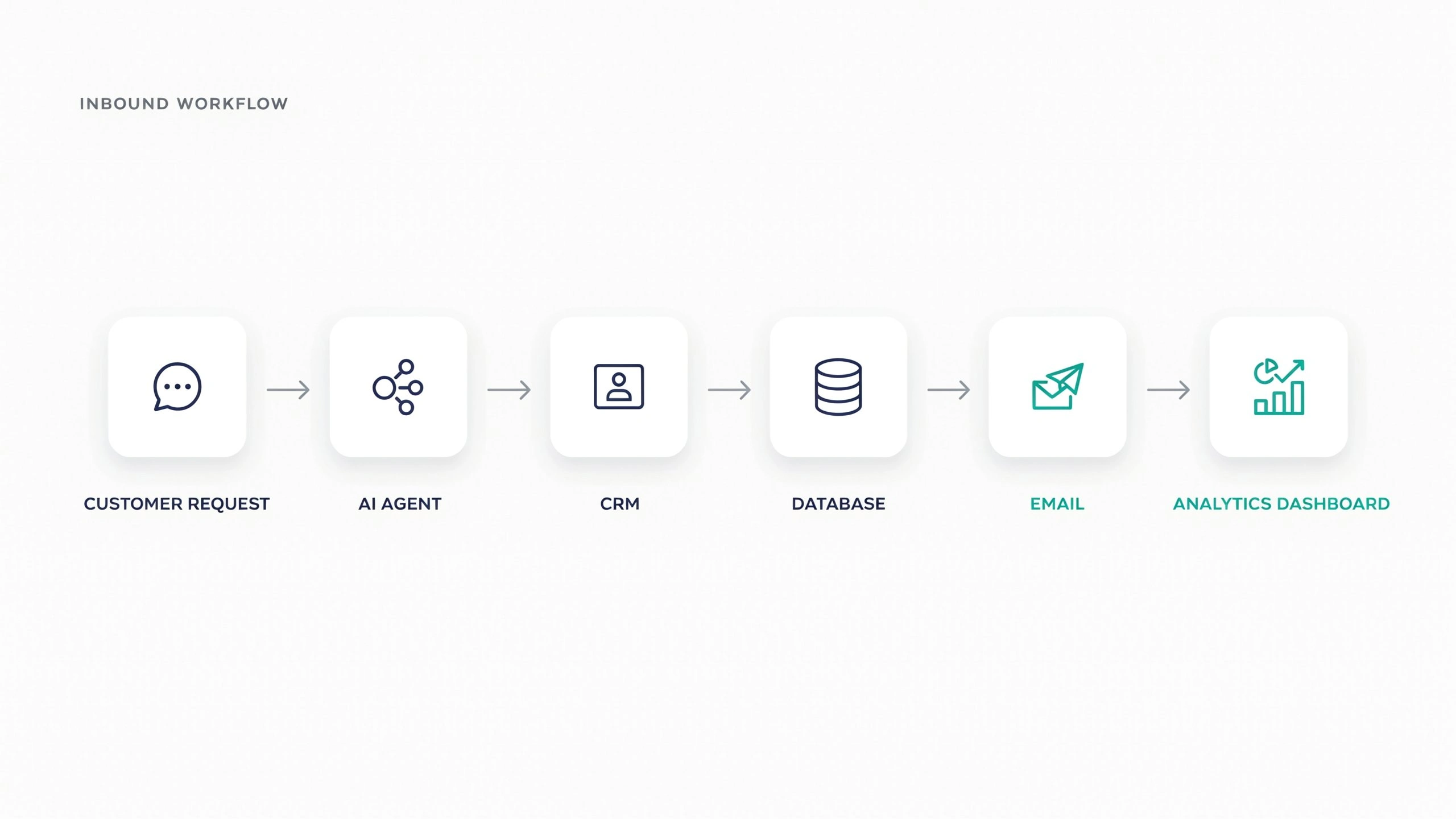
The distinction matters practically. A generative AI tool helps a customer support agent write a better reply. An agentic AI system reads the incoming support ticket, looks up the customer’s account history, checks whether similar issues have been reported, drafts a resolution based on internal documentation, and routes the ticket to the right team if escalation is needed. The human reviews the output and approves it. The agent did the work.
AI agents in business operations today handle tasks like:
Monitoring inbound leads, enriching them with data from external sources, scoring them against qualification criteria, and adding them to CRM pipelines with drafted outreach messages.
Reading incoming invoices, extracting line items, matching them against purchase orders, flagging discrepancies, and routing approved invoices for payment.
Responding to customer inquiries using knowledge base retrieval, escalating to human agents when confidence is low, and logging every interaction with structured data for reporting.
Scheduling, rescheduling, and following up on appointments across calendar systems without any manual coordination.
These are not chatbot interactions. They are multi-step autonomous workflows where the AI owns execution and humans maintain oversight at defined checkpoints.
Why Large Companies Are Struggling With AI Adoption
Technology is rarely the primary obstacle to enterprise AI adoption. The obstacles are organizational.
Large enterprises run on legacy systems that accumulated over decades. ERP systems, CRM platforms, proprietary databases, and custom-built internal tools form an interconnected infrastructure where each system has dependencies that complicate any modification. Integrating AI agents into this environment requires either expensive custom development or extensive middleware that slows deployment timelines significantly.
Organizational silos mean that a workflow spanning multiple departments requires coordination across multiple stakeholders with competing priorities. An AI automation that improves customer support efficiency but changes how the sales team receives handoffs requires buy-in from both departments, approval from both department heads, and alignment on new processes before a single workflow runs.
Resistance to change is not irrational in large organizations. Employees with established workflows and years of domain knowledge see AI automation as a threat to their roles and their expertise. Managing that resistance requires change management programs that take months and still do not always succeed.
Approval processes that work well for stable operations become bottlenecks for rapid AI deployment. A small business can test a new automated workflow in an afternoon. An enterprise might require security review, compliance sign-off, IT change management approval, and legal review before the same workflow reaches production.
The result is that many large enterprises are running AI pilots indefinitely, producing proofs of concept that never reach production scale while smaller competitors ship and iterate in weeks.
Why Small Businesses Have the Advantage
They Build AI Into Their Workflows From Day One
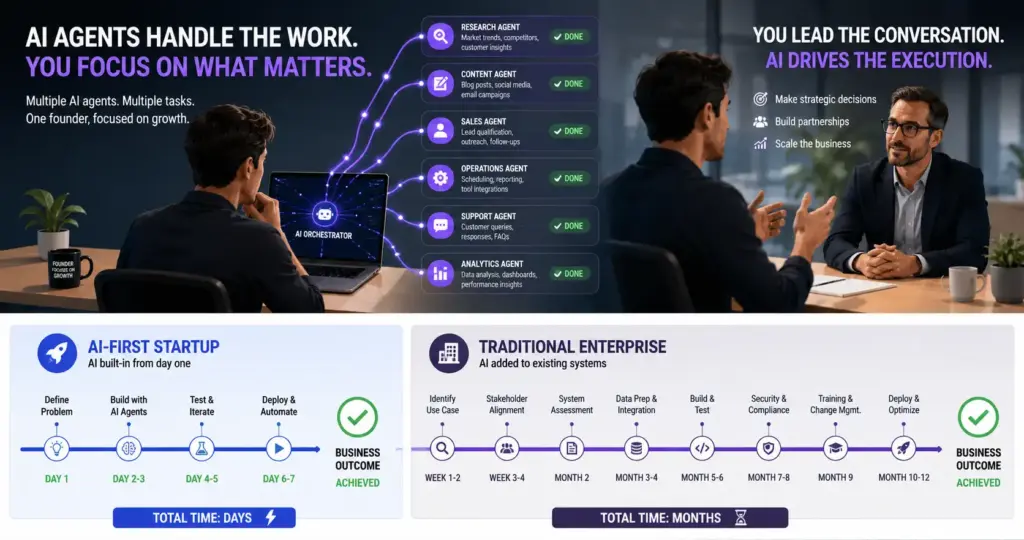
A small business starting operations today does not have a legacy CRM that three departments depend on and nobody is allowed to touch. It chooses tools that integrate with AI from the start, designs workflows that assume AI agent participation, and never accumulates the technical debt that makes automation difficult later.
When the business process and the AI workflow are designed together, integration is natural rather than retrofitted. The agent is not added to an existing process. The process is built around what the agent can do.
Faster Decision Making
A founder or small leadership team can decide to deploy a new AI workflow, test it, and put it into production within days. There is no steering committee, no IT change management board. There is no six-month vendor evaluation process. The speed of decision making translates directly into speed of competitive advantage.
Fewer Legacy Systems
Small businesses operate with modern cloud tools: Notion, Airtable, HubSpot, Stripe, Slack, Google Workspace. These platforms expose APIs, support webhooks, and integrate readily with automation platforms. Building AI agents that connect them requires configuration, not engineering. Large enterprises with on-premise systems, proprietary databases, and decade-old software face integration challenges that small businesses never encounter.
Greater Operational Flexibility
When an AI-first small business identifies a better way to run a process, it implements the change. When a large enterprise identifies the same improvement, it enters a change management cycle that may take months before any operational change happens. The ability to continuously refine AI workflows gives small businesses a compounding advantage over time.
Lower Implementation Costs
Self-hosted automation platforms like n8n run on a VPS for $10 to $30 per month. AI model APIs via OpenRouter give access to hundreds of models with per-token pricing that costs cents per workflow execution. A small business can build and run sophisticated agentic workflows for a few hundred dollars per month in total infrastructure cost. The same capability in an enterprise context, bought through vendors, costs tens of thousands of dollars annually.
AI-First Companies vs Companies Retrofitting AI
| Dimension | AI-First Businesses | Traditional Businesses |
|---|---|---|
| Workflow design | Built around AI from the start | AI added to existing workflows |
| Deployment speed | Days to weeks | Months to years |
| Organizational resistance | Minimal | Significant |
| Legacy system constraints | None or minimal | Extensive |
| Implementation cost | Low | High |
| Iteration speed | Fast | Slow |
| Scaling approach | Add agents and workflows | Complex change management |
The performance gap between these two categories is not primarily a technology gap. It is a design philosophy gap. Companies that ask “how do we add AI to what we already do” are competing on different terms than companies that ask “how do we design our operations around what AI can do.”
Real-World Examples of Agentic AI Success
Forbes has reported on several cases that illustrate how agentic AI is already producing competitive advantages for smaller, faster-moving organizations.
In one reported case, a travel booking operation used agentic AI to handle end-to-end booking workflows that previously required manual coordination across multiple systems and team members. The automation handled the orchestration layer, leaving human staff to focus on exceptions and relationship management rather than routine transaction processing.
In another reported case, a marketing agency used AI agents to automate creative workflow stages that had previously required significant manual handoffs between team members. The result was faster campaign delivery with the same headcount.
These cases share a common pattern: the AI does not replace the team. It owns defined workflow stages, handles the orchestration and data movement, and surfaces exceptions for human decision-making. The team focuses on work that requires human judgment because the routine coordination work no longer lands on their desks.
Customer support automation is producing similar results across industries. Businesses running AI agents on first-response handling report significant reductions in first-response time and increases in resolution rate on common queries, with human agents handling only escalated and complex issues.
How Agentic AI Is Transforming Small Business Operations
Customer service is the most widely deployed area. AI agents read incoming inquiries, retrieve relevant information from knowledge bases, draft responses, and handle resolution for common issues autonomously. Human agents review edge cases and handle emotionally complex situations.
Marketing workflows benefit from agents that monitor content performance, draft variations based on performance data, schedule social posts, segment contact lists based on behavior, and trigger personalized email sequences without manual campaign management for each step.
Sales operations deploy agents that qualify inbound leads based on defined criteria, enrich contact data from external sources, draft outreach sequences, schedule follow-up tasks, and update CRM records after each interaction.
Finance processes including invoice processing, expense categorization, payment scheduling, and reconciliation are natural fits for agentic automation because they involve structured data, defined rules, and high repetition.
HR functions like scheduling interviews, sending offer letters, triggering onboarding workflows, and managing document collection routes well to AI agents because the steps are consistent and the required integrations are well-defined.
Inventory management, appointment scheduling, document processing, and internal knowledge management follow the same pattern: structured tasks with defined inputs and outputs where AI agents own execution and humans maintain oversight at decision points.
Building an AI-First Business
Identify repetitive workflows. Start by listing every task in your business that follows a consistent pattern. Consistent inputs, consistent process steps, consistent outputs. These are the workflows where AI agents produce the highest return.
Start with one business function. Pick one department or one workflow category and automate it completely before expanding. Trying to automate everything simultaneously produces partial implementations that never reach reliability.
Assign clear ownership to AI agents. Define exactly which tasks the agent owns, what decisions it can make independently, and what it escalates to humans. Unclear boundaries produce workflows where neither the agent nor the human is fully responsible for outcomes.
Keep humans in the approval loop where needed. Agentic AI works best when humans define the guardrails and approve outputs at high-stakes decision points rather than reviewing every step. Design approval checkpoints into workflows rather than attempting full automation of consequential decisions immediately.
Measure outcomes from the start. Define what success looks like before deploying any agent. Response time, error rate, tasks completed per day, cost per resolution. Measurement makes it possible to improve and to recognize when a workflow needs human adjustment.
Expand gradually. Once one workflow runs reliably, add the next. The compounding effect of multiple well-designed agentic workflows produces operational leverage that grows over time.
Common Mistakes Small Businesses Should Avoid
Automating broken processes. An AI agent running a broken process runs it faster and at higher volume. Before automating any workflow, fix the underlying process logic. Automation amplifies whatever is already there, good or bad.
Expecting AI to replace every employee. Businesses that deploy agentic AI with the expectation of eliminating headcount entirely usually produce worse outcomes than businesses that deploy it to increase what their existing team can accomplish. Agents handle routine execution. Humans handle judgment, relationships, and exceptions.
Ignoring data quality. AI agents are only as good as the data they work with. An agent that reads customer records, enriches leads, or processes invoices produces poor output when the underlying data has inconsistencies, gaps, or errors. Data quality is a prerequisite for reliable agentic automation, not an afterthought.
Choosing too many AI tools simultaneously. The market for AI automation tools is crowded. Businesses that adopt five automation platforms, three AI models, and two orchestration layers simultaneously create integration complexity that slows everything down. Pick one orchestration platform, one primary model provider, and expand from there.
Lack of human oversight. Fully autonomous systems that make consequential decisions without any human checkpoint are higher risk than hybrid systems with defined review points. Oversight is not a limitation on AI capability. It is a design feature that makes AI systems trustworthy enough to deploy on business-critical workflows.
Not monitoring AI performance. Deployed agents drift over time. External APIs change, input data patterns shift, edge cases accumulate. Monitoring agent performance with defined metrics and reviewing failure cases regularly is what keeps agentic workflows reliable over months of operation.
Tools That Help Build Agentic AI Workflows
n8n workflow automation is the orchestration layer most commonly used for building multi-step agentic workflows. It connects APIs, databases, communication tools, and AI models through a visual workflow editor with Code nodes for custom logic. Its MCP integration allows AI agents to discover and call tools dynamically.
Ollama enables running open-source language models locally on a server, providing AI inference without per-token API costs for appropriate workloads.
OpenAI and Anthropic Claude provide the reasoning layer for agents that need strong instruction following, structured output generation, and tool calling reliability.
Model Context Protocol (MCP) standardizes how AI agents discover and call external tools. It allows one agent to access tools registered in multiple MCP servers without custom integration for each tool.
Vector databases like Pinecone, Qdrant, and Chroma store and retrieve document embeddings for retrieval augmented generation, allowing agents to search and reference large knowledge bases during workflow execution.
CRMs, knowledge bases, and communication platforms connect to the orchestration layer through native integrations or API calls, giving agents access to the business data they need to complete their assigned workflows.
The key is not which tools you use. It is how they connect into autonomous workflows where the agent owns execution across multiple steps rather than generating a single output that a human processes manually.
What the Future Looks Like
The trajectory of agentic AI points toward systems where multiple specialized agents collaborate on complex tasks. One agent handles customer intake, another handles data retrieval, another handles drafting, and an orchestrating agent coordinates the sequence. Multi-agent systems divide work based on specialization the same way human teams do.
Small teams will run operations that previously required much larger headcounts. Not because humans are replaced, but because each human’s scope of oversight and strategic decision-making expands when routine execution is handled by agents working in parallel.
Personalized business operations become practical at small scale. Agents that track individual customer preferences, adapt communication style based on interaction history, and adjust service delivery based on customer behavior produce personalization that previously required dedicated human relationship management.
Human oversight remains essential and will remain essential. The question is not whether humans stay in the loop but where the loop is. As agents become more reliable on well-defined tasks, the human oversight point moves up the decision stack toward the judgments that genuinely require human experience and accountability.
AI is becoming an operational layer rather than a standalone tool. It is not something businesses use for specific tasks. It is the infrastructure through which business processes run. The businesses building that infrastructure into their operations now are accumulating the workflow knowledge, the agent reliability data, and the operational experience that will compound into durable competitive advantages.
Conclusion
Winning the AI race is not about deploying the most advanced model or spending the most on AI infrastructure. It is about designing workflows where AI owns well-defined tasks, executes them reliably, and surfaces the right decisions for human judgment.
The businesses that will look back on this period as a turning point are not the ones that watched the technology mature before committing. They are the ones that started now, built one workflow at a time, measured what worked, and kept building. The compounding advantage of earlier adoption grows with every workflow added, every agent refined, and every hour of human attention redirected from routine execution to genuinely consequential work.
Are you ready to move beyond experimentation? Deploy your n8n workflows and AI agents on a KVM VPS hosting and build an automation infrastructure that grows with your business.
FAQ
1. What is agentic AI?
Agentic AI refers to AI systems that can independently plan, make decisions, and complete multi-step tasks by interacting with tools, applications, and data with minimal human intervention.
2. Why are small businesses adopting agentic AI faster than large enterprises?
Small businesses have fewer legacy systems, simpler workflows, and faster decision-making processes, making it easier to integrate AI into daily operations from the start.
3. Do small businesses need expensive infrastructure to use agentic AI?
Not necessarily. Many agentic AI solutions can run on cloud platforms or self-hosted environments using tools like n8n, Ollama, and modern AI models, allowing businesses to start small and scale as needed.
4. What is the biggest challenge when implementing agentic AI?
The biggest challenge is redesigning business workflows so AI agents can take ownership of specific tasks, rather than simply adding AI to existing manual processes.