

Data compliance is not optional anymore. GDPR fines hit €20 million or 4% of global turnover. HIPAA breaches cost $10.93 million per incident on average.SOC 2 failure kills customer trust instantly.
Managed dedicated servers solve this problem. They combine hardware isolation, compliance tools, 24/7 monitoring, and expert support in one solution. You get full control with built-in safeguards. No compliance headaches. No surprise audits.
This guide shows why managed dedicated hosting wins for regulated industries.
What Is Managed Dedicated Server Hosting?
Managed dedicated servers provide exclusive hardware resources with full technical management by hosting experts. You get complete server control without handling maintenance, security updates, or compliance configuration.
Core Components of Managed Hosting
Dedicated Hardware
Entire server exclusively assigned to your business. No resource sharing with other websites.
Expert Management Team
System administrators handle server optimization, security patches, and compliance setup.
Proactive Monitoring
24/7 surveillance detects threats before they impact operations. Average response time: under 15 minutes.
Compliance Infrastructure
Pre-configured environments meeting GDPR, HIPAA, PCI DSS, and SOC 2 requirements.
How Managed Differs from Unmanaged
| Feature | Unmanaged | Managed |
| Hardware setup | You do it | Provider does it |
| OS updates & patches | You apply | Provider applies |
| Monitoring (24/7) | You set up | Provider monitors |
| Security hardening | You configure | Provider hardens |
| Backup management | Your responsibility | Provider handles |
| Incident response | You respond | Provider responds |
| Compliance audits | You prepare | Provider assists |
Who Needs Managed Dedicated Hosting for Compliance?
Managed dedicated hosting is essential for organizations that handle regulated, sensitive, or high-risk data.
If compliance failures can trigger fines, lawsuits, or loss of trust, shared or unmanaged hosting is not enough.
Healthcare and HealthTech Companies
Hospitals, clinics, telemedicine platforms, and health SaaS providers must comply with HIPAA.
Patient records require strict access control, audit logs, encryption, and signed BAAs.
Managed dedicated servers provide the required technical and physical safeguards.
Financial Services and FinTech Businesses
Banks, NBFCs, payment gateways, and lending platforms process sensitive financial data.
They must meet PCI DSS, SOC 2, and regional privacy laws.
Dedicated infrastructure prevents data leakage and supports continuous compliance monitoring.
SaaS Companies Serving Enterprises
Enterprise customers demand SOC 2 reports and data isolation.
Managed dedicated hosting delivers controlled environments, uptime guarantees, and audit-ready documentation.
This shortens sales cycles and improves customer trust.
E-commerce Stores Handling Payment Data
Online stores processing card payments face strict PCI DSS requirements.
Managed servers enforce firewall rules, encryption, and real-time monitoring.
This reduces breach risk during high-traffic periods.
Legal, Government, and Public Sector Vendors
Law firms, government contractors, and public service platforms manage confidential records.
Data sovereignty and access logging are mandatory.
Managed dedicated hosting ensures full traceability and secure storage.
Businesses Handling EU or Cross-Border User Data
Any company storing EU citizen data must comply with GDPR.
Data residency, breach monitoring, and DPAs are non-negotiable.
Managed providers simplify these obligations with EU-based infrastructure.
Companies Without In-House Compliance Teams
Small and mid-sized businesses often lack security specialists.
Managed hosting replaces internal expertise with proven compliance frameworks.
This lowers operational risk and server cost.
How Managed Dedicated Servers Address GDPR Requirements
GDPR applies to any business holding EU citizen data. Shared hosting violates GDPR because data from multiple customers sits on the same hardware.
Managed dedicated servers fix this. Single-tenant isolation means your data never mixes with another company’s.
Technical Requirements Managed Servers Handle
Encryption:
Managed providers implement AES-256 encryption for data at rest and in transit. You get SSL certificates, encrypted backups, and database encryption built in. No extra setup needed.
Access control:
Managed servers use role-based access control (RBAC). Only people who need specific data access get it.Multi-factor authentication (MFA) blocks unauthorized logins.
Data processing agreement:
Managed hosting providers sign Data Processing Agreements (DPAs) with you. This legal document proves compliance to auditors.
Audit logging:
Every action logs automatically. Who accessed data. When. Why. This audit trail proves GDPR compliance during inspections.
72-hour breach notification:
Managed providers monitor for breaches 24/7. If a breach occurs, your provider alerts you immediately, giving you time to notify affected users within the 72-hour window.
EU Data Residency
GDPR requires EU citizen data to stay in EU data centers. Managed providers offer this. Your data never leaves Europe unless explicitly approved.

HIPAA Compliance: Critical for Healthcare
For a full overview of federal healthcare data protection requirements, refer to the HIPAA regulation overview published by the U.S. Department of Health & Human Services.
HIPAA’s Three-Layer Requirement
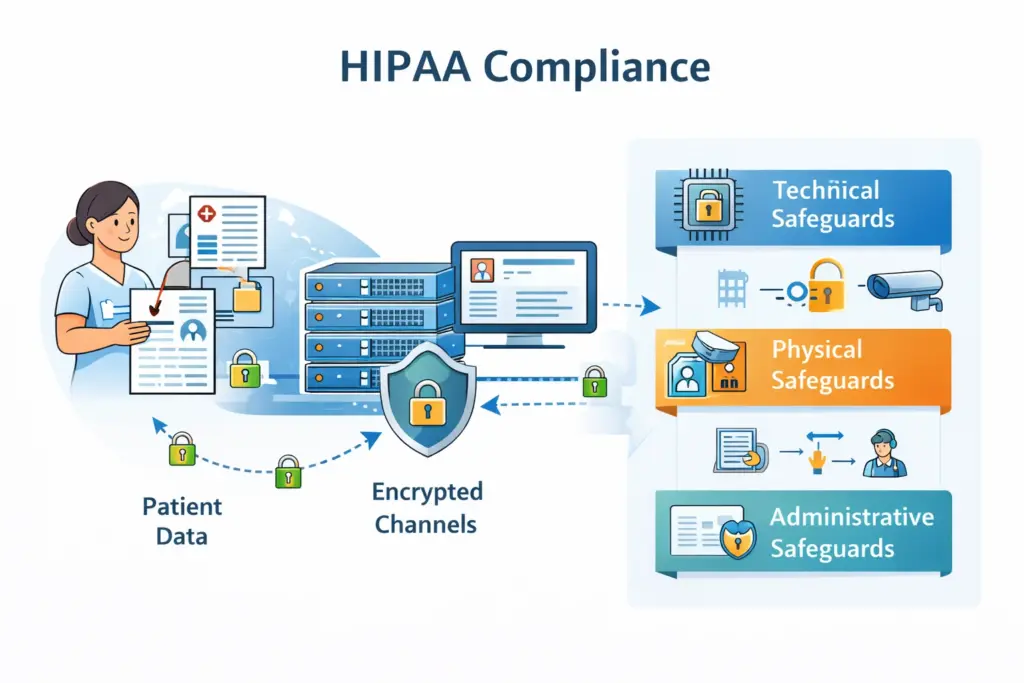
HIPAA demands three compliance layers: technical, physical, and administrative.
Technical safeguards:
- Encryption at rest and in transit
- Access controls and authentication
- Audit logging and monitoring
- Vulnerability scanning and patching
- Backup and recovery systems
Managed servers include all of these.
Physical safeguards:
- Data center locks and surveillance
- Restricted access, biometric entry
- Environmental controls (temperature, humidity)
- Disaster recovery facilities
Your managed provider operates the data center. You inherit their physical security.
Administrative safeguards:
- Workforce training on data protection
- Incident response plans
- Business associate agreements (BAAs)
- Regular risk assessments
Managed providers maintain these policies and share them with you during onboarding.
Business Associate Agreement (BAA)
HIPAA requires a signed BAA between your business and your hosting provider. This document says the provider will handle patient data securely.
Managed dedicated hosting providers offer BAAs automatically. Unmanaged providers often refuse because they lack the compliance infrastructure.
SOC 2 and Other Compliance Standards
What SOC 2 Audits Check
SOC 2 audits verify that your infrastructure meets five trust criteria:
- Security (controls prevent unauthorized access)
- Availability (systems stay online)
- Processing integrity (data is accurate and complete)
- Confidentiality (sensitive data stays private)
- Privacy (personal data is handled correctly)
Managed dedicated servers meet all five because providers maintain documented, tested controls.
Other Standards Managed Servers Support
| Standard | What It Is | Managed Server Support |
| PCI DSS | Payment card data protection | Firewall rules, encryption, logging |
| ISO 27001 | Information security management | Documented controls, audits, testing |
| HIPAA | Healthcare data protection | BAA, technical/physical/admin safeguards |
| GDPR | EU data protection | Encryption, DPA, data residency, audit logs |
| SOC 2 | Trust service criteria | Controls testing, compliance documentation |
Managed providers are often already certified. You inherit their certifications.
Cheap Managed Dedicated Hosting with Proactive Support
What “Proactive Support” Means
Reactive Support (Traditional Model)
Customer reports issue → Support investigates → Problem resolved
Proactive Support (Managed Model)
System detects anomaly → Support fixes before customer notices → Customer notified of resolution
Real-World Proactive Support Examples
Scenario 1: Disk Space Prevention
Detection: Server reaches 75% disk capacity
Action: Support team archives old logs, optimizes databases
Result: Disk usage reduced to 58%
Customer Impact: Zero. Issue prevented before affecting operations.
Scenario 2: SSL Certificate Renewal
Detection: Certificate expires in 30 days
Action: Automatic renewal, installation, verification
Result: Zero downtime, continuous encryption
Customer Impact: Seamless. No manual intervention required.
Scenario 3: Security Patch Deployment
Detection: Critical kernel vulnerability announced
Action: Test patch in staging, deploy to production during low-traffic period
Result: Server secured within 8 hours of disclosure
Customer Impact: Protected without service interruption.
Support Response Time Guarantees
| Issue Severity | First Response | Resolution Target |
| Critical (Server down) | 5 minutes | 1 hour |
| High (Service degraded) | 15 minutes | 4 hours |
| Medium (Non-urgent issue) | 1 hour | 24 hours |
| Low (General inquiry) | 4 hours | 48 hours |
After-Hours Support
24/7/365 availability via phone, live chat, and ticket system. No additional fees.
Managed Dedicated Server with cPanel and WHM Support
User Management Simplification
Create isolated accounts for different departments. Each account has separate file permissions and resource limits.
Automated Backup Configuration
Schedule daily backups to remote storage. Retention periods configurable per compliance requirements (HIPAA: 6 years, GDPR: varies by data type).
SSL Certificate Management
One-click Let’s Encrypt integration. Automatic renewal prevents encryption lapses.
Email Account Auditing
Track sent/received emails for compliance documentation. Search functionality for e-discovery requests.
WHM (Web Host Manager) for Multi-Tenant Compliance
Reseller Account Segregation
Each client operates in isolated environment. Resource quotas prevent one account from impacting others.
Compliance Template Application
Deploy standardized security configurations across multiple accounts simultaneously.
Audit Trail Generation
WHM logs all administrative actions: account creation, package changes, IP modifications.
cPanel Security Features for Compliance
ModSecurity Web Application Firewall
Pre-configured rulesets block:
- SQL injection attempts
- Cross-site scripting (XSS)
- File inclusion attacks
- Remote code execution
Detection rate: 98.7% (OWASP Top 10 coverage)
To understand how a Web Application Firewall protects applications from attacks such as SQL injection and XSS, see this Web Application Firewall explained resource.
IP Blocker
Blacklist malicious IPs automatically. Integration with threat intelligence feeds updates blocklist hourly.
Directory Privacy (Password Protection)
Restrict sensitive directories with .htaccess authentication. Supports integration with LDAP/Active Directory.
Hotlink Protection
Prevents bandwidth theft and unauthorized content embedding important for protecting proprietary medical images or financial documents.
How Managed Dedicated Servers Improve Website Performance
Performance Optimization Techniques
Database Query Optimization
Before Optimization:
Average query time: 2.3 seconds
Slow query log: 847 problematic queries
After Managed Optimization:
Average query time: 0.18 seconds
Slow queries eliminated: 98%
Optimization Methods:
- Index creation on frequently queried columns
- Query result caching (Redis)
- Connection pooling
- Partition large tables
- Remove duplicate indexes
Content Delivery Network (CDN) Integration
Performance Impact:
| Metric | Without CDN | With CDN | Improvement |
| Page Load Time (USA) | 3.2s | 0.9s | 72% faster |
| Page Load Time (Europe) | 5.8s | 1.1s | 81% faster |
| Page Load Time (Asia) | 7.1s | 1.3s | 82% faster |
| Bandwidth Usage | 2.4 TB | 0.6 TB | 75% reduction |
This same architecture also supports dedicated hosting for streaming workloads where low latency and consistent throughput are mandatory.
Image Optimization
Compression Standards:
- JPEG quality: 85% (imperceptible quality loss)
- PNG: TinyPNG compression
- WebP conversion: 30% smaller than JPEG
- Lazy loading: Images load only when scrolling into view
Average savings: 68% file size reduction
Caching Strategy Implementation
Browser Caching
Static assets cached for 1 year (CSS, JS, images). HTML cached for 1 hour.
Server-Side Caching
OPcache for PHP (bytecode caching). APC for object caching.
Database Query Caching
Memcached stores frequent query results. Cache invalidation on data updates.
Result: 89% reduction in server processing time for repeat visitors.
Managed Hosting Solutions with Root Access and Full Control
Balancing Management with Control
Common Misconception:
“Managed hosting means losing control over server configuration.”
Reality:
You retain full root access while experts handle routine maintenance and compliance tasks.
What You Control
Software Installation
Install any application compatible with your OS. No restrictions on custom software stacks.
Custom Configuration
Modify web server settings (Apache, Nginx). Adjust PHP parameters. Configure database optimization variables.
Firewall Rules
Add custom iptables rules. Whitelist/blacklist specific IPs. Configure port forwarding.
Cron Jobs
Schedule automated tasks at any frequency. Run custom scripts for business logic.
What Managed Support Handles
Operating System Updates
Security patches applied during maintenance windows. Kernel updates tested before deployment.
Security Monitoring
24/7 intrusion detection. Malware scanning. Log analysis for suspicious activity.
Backup Management
Daily automated backups. Offsite storage. Restoration assistance when needed.
Performance Optimization
Database tuning. Cache configuration. Resource allocation adjustments.
Root Access Use Cases
Compliance Scenario: HIPAA Audit Preparation
Your Responsibilities:
- Configure application-level access controls
- Implement business logic for data retention
- Set up user authentication workflows
Managed Support Responsibilities:
- Ensure OS-level security hardening
- Configure audit logging infrastructure
- Maintain encryption key management
- Verify backup encryption
Collaboration Result:
Audit completed successfully. Zero findings. Combined expertise addressed all requirements.
cPanel and WHM Support: Full Root Access
Some compliance requirements need low-level server access. cPanel and WHM give you this without exposing raw systems.
cPanel = user-friendly control panel for website owners and developers.
WHM = server-level management tool for root administrators.
What You Can Do with WHM
From WHM, you manage:
- Create hosting accounts and assign resource limits
- Configure firewall rules (whitelist/blacklist IPs)
- Install security modules (ModSecurity WAF)
- Set up SSL certificates and encryption
- Monitor CPU, RAM, and disk usage
- Manage backups and recovery
- Configure email routing and filtering
- Install custom applications
This level of control lets you implement custom compliance policies without waiting for provider approval.
cPanel Features for Compliance
From cPanel, non-root users can:
- Create email accounts with specific quotas
- Manage SSH keys and access
- Install SSL certificates
- Set up automated backups
- Monitor bandwidth and resource usage
- Manage databases and access controls
24/7 Monitoring and Proactive Support
Compliance violations happen outside business hours. A breach at 2 AM still violates GDPR if you do not notify users within 72 hours.
Managed providers monitor 24/7. They detect:
- Unauthorized access attempts
- Malware or intrusion activity
- System failures and outages
- Performance degradation
And they respond immediately.
Monitoring Tools Managed Providers Use
| Tool | Purpose |
| SIEM (Security Information & Event Management) | Centralizes log analysis, detects threats |
| IDS/IPS (Intrusion Detection/Prevention) | Watches network traffic for attacks |
| File Integrity Monitoring | Alerts if critical files change |
| Vulnerability Scanning | Finds security gaps automatically |
| Uptime Monitoring | Checks site availability every minute |
Affordable Managed Dedicated Server Hosting Plans for Businesses
| Server Plan | Monthly Price | CPU | Cores / Threads | Clock Speed | RAM | Storage | Bandwidth | cPanel | Setup |
|---|---|---|---|---|---|---|---|---|---|
| Xeon D1540 | $135.00 | Intel Xeon D1540 | 4C / 4T | 3.2 GHz | 64GB DDR3 ECC | SoftRAID 2×450GB NVMe | Unlimited on 250 Mbps | Free (100 Accounts) | Free |
| Xeon E3-1245v5 (SATA) | $148.00 | Intel Xeon E3-1245v5 | 4C / 8T | 3.5 GHz | 16GB DDR4 ECC | SoftRAID 2×4TB SATA | Unlimited on 250 Mbps | Free (100 Accounts) | Free |
| Xeon E3-1245v5 (NVMe) | $148.00 | Intel Xeon E3-1245v5 | 4C / 8T | 3.5 GHz | 16GB DDR4 ECC | SoftRAID 2×450GB NVMe | Unlimited on 250 Mbps | Free (100 Accounts) | Free |
| Xeon E3-1230v6 | $151.00 | Intel Xeon E3-1230v6 | 4C / 8T | 4.0 GHz | 16GB DDR4 ECC | SoftRAID 2×450GB NVMe | Unlimited on 250 Mbps | Free (100 Accounts) | Free |
| Xeon E3-1270v6 (32GB) | $167.00 | Intel Xeon E3-1270v6 | 6C / 12T | 3.5 GHz | 32GB DDR4 ECC | SoftRAID 2×450GB NVMe | Unlimited on 250 Mbps | Free (100 Accounts) | Free |
| Xeon E3-1270v6 (64GB) | $178.00 | Intel Xeon E3-1270v6 | 4C / 8T | 3.7 GHz | 64GB DDR4 ECC | SoftRAID 2×2TB SATA | Unlimited on 250 Mbps | Free (100 Accounts) | Free |
Cost-Saving Strategies
Annual prepayment: Pay yearly instead of monthly. Save 10–20%.
Right-sizing: Start small. Upgrade only when needed. Most businesses overprovision.
Before committing long term, review a dedicated server cost comparison to understand pricing differences based on hardware, management level, and compliance needs.
Bundling: Add managed services only where needed. Skip what you can handle internally.
Future-Proofing Your Compliance Infrastructure
Modern compliance strategies increasingly rely on edge-ready dedicated hosting to reduce latency while maintaining centralized control over sensitive data.
Emerging Compliance Regulations
California Consumer Privacy Act (CCPA) Amendments
Effective January 2025. Expands data subject rights beyond California residents.
Preparation Steps:
- Implement automated data subject request handling
- Add “Do Not Sell My Information” functionality
- Extend data retention policies
- Update privacy notices
AI and Machine Learning Regulations
EU AI Act expected 2026. Classifies AI systems by risk level.
Compliance Requirements:
- Document AI training data sources
- Implement algorithmic transparency measures
- Establish human oversight protocols
- Regular bias audits
Technology Trends Impacting Compliance
Quantum-Safe Encryption
NIST post-quantum cryptography standards finalized 2024.
Migration Timeline:
- 2025-2026: Test quantum-resistant algorithms
- 2027-2028: Hybrid classical/quantum encryption
- 2029-2030: Full quantum-safe implementation
Zero Trust Architecture
Moving from perimeter security to continuous verification.
Implementation Components:
- Micro-segmentation of network resources
- Device health verification before access
- Continuous authentication monitoring
- Least-privilege access enforcement
Why Ucartz Makes Sense for Compliance
A strong managed dedicated hosting provider offers:
Compliance-ready infrastructure:
- GDPR DPA included
- HIPAA BAA available
- EU data residency options
- SOC 2 Type II certified (or pursuing)
Performance optimized:
- Enterprise-grade CPUs (Xeon/EPYC)
- NVMe SSD storage
- Redundant power and cooling
Security included:
- Hardware firewall
- DDoS protection (basic free, advanced paid)
- Automated vulnerability scanning
- 24/7 security monitoring
Management tools:
- cPanel/WHM for full root control
- Managed backups with retention policies
- Proactive patch management
Support that understands compliance:
- 24/7 expert technicians
- Response time under 1 hour
- Compliance expertise (not generic hosting support)
Conclusion
Managed dedicated hosting removes compliance headaches. You stop worrying about whether your data meets GDPR, HIPAA, or SOC 2 standards. Your provider handles the heavy lifting.
The result: Lower risk, faster audits, better performance, and lower operational costs.
For any business handling sensitive data healthcare, finance, legal, government contracting managed dedicated hosting is not a luxury. It is a requirement.
Start with an affordable hosting plan. Scale up as you grow. Pay less than you would for compliance consultants.
Ucartz.com provides complete dedicated hosting solutions with enterprise features at business-friendly prices. Our infrastructure, security, and support enable businesses to focus on growth while we handle technology.
FAQ
Q1: What is managed dedicated hosting?
Managed dedicated hosting provides a powerful, single-tenant physical server where the hosting provider handles all setup, security updates, monitoring, and technical support for you.
Q2: Why is dedicated hosting better for GDPR or HIPAA compliance?
A dedicated server ensures complete data isolation and provides the necessary controlled environment for implementing strict access logs and security controls required by regulations like GDPR and HIPAA.
Q3: Can a managed host help me pass a compliance audit?
Yes, a reputable managed host provides critical audit documentation, like access logs and security reports, and maintains a compliant infrastructure, which forms a key part of your evidence.
Q4: What compliance features should I look for in a host?
Look for providers that offer data encryption (at rest and in transit), detailed activity logging, robust physical security at data centers, and signed Business Associate Agreements (BAAs) for HIPAA.
Q5: Is managed dedicated hosting more expensive for compliance?
While the initial cost is higher than unmanaged options, it is often more cost-effective than building a compliant in-house data center and mitigates huge potential fines for non-compliance.