

In February 2025, the operations manager at a digital marketing agency noticed a number that made her stop scrolling. The agency had closed 23 infrastructure-related support tickets in a single month.It was related to Hosting issues.
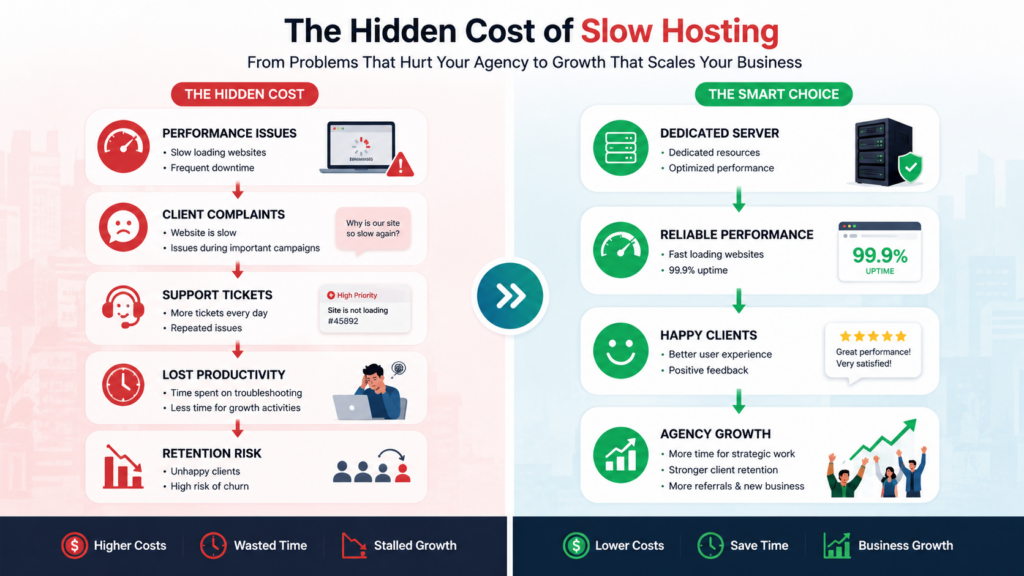
Slow websites. Timeout errors. A WooCommerce store that struggled whenever promotions went live. A healthcare provider’s patient portal that took more than 8 seconds to load during Monday morning rush hours. None of the websites were completely down. That was the problem.
Full outages trigger alarms and immediate action. Persistent slowness is different. It sits just below the threshold of a major incident while quietly frustrating clients, consuming staff time, and eroding confidence week after week.
One healthcare client had raised concerns twice during quarterly business reviews. An e-commerce client had stopped running flash-sale promotions after previous campaigns caused the website to slow dramatically under traffic spikes.
Internally, the BrightPeak team felt like they were having the same conversation every week.
“The websites weren’t completely down, but they weren’t consistently fast either. That’s often worse because clients lose confidence and they start wondering whether the agency actually knows what it’s doing.”
– Neena K, Operations Manager, Digital marketing agency
What initially looked like a technical issue was becoming a business problem.
The Hidden Cost of Hosting Fragmentation
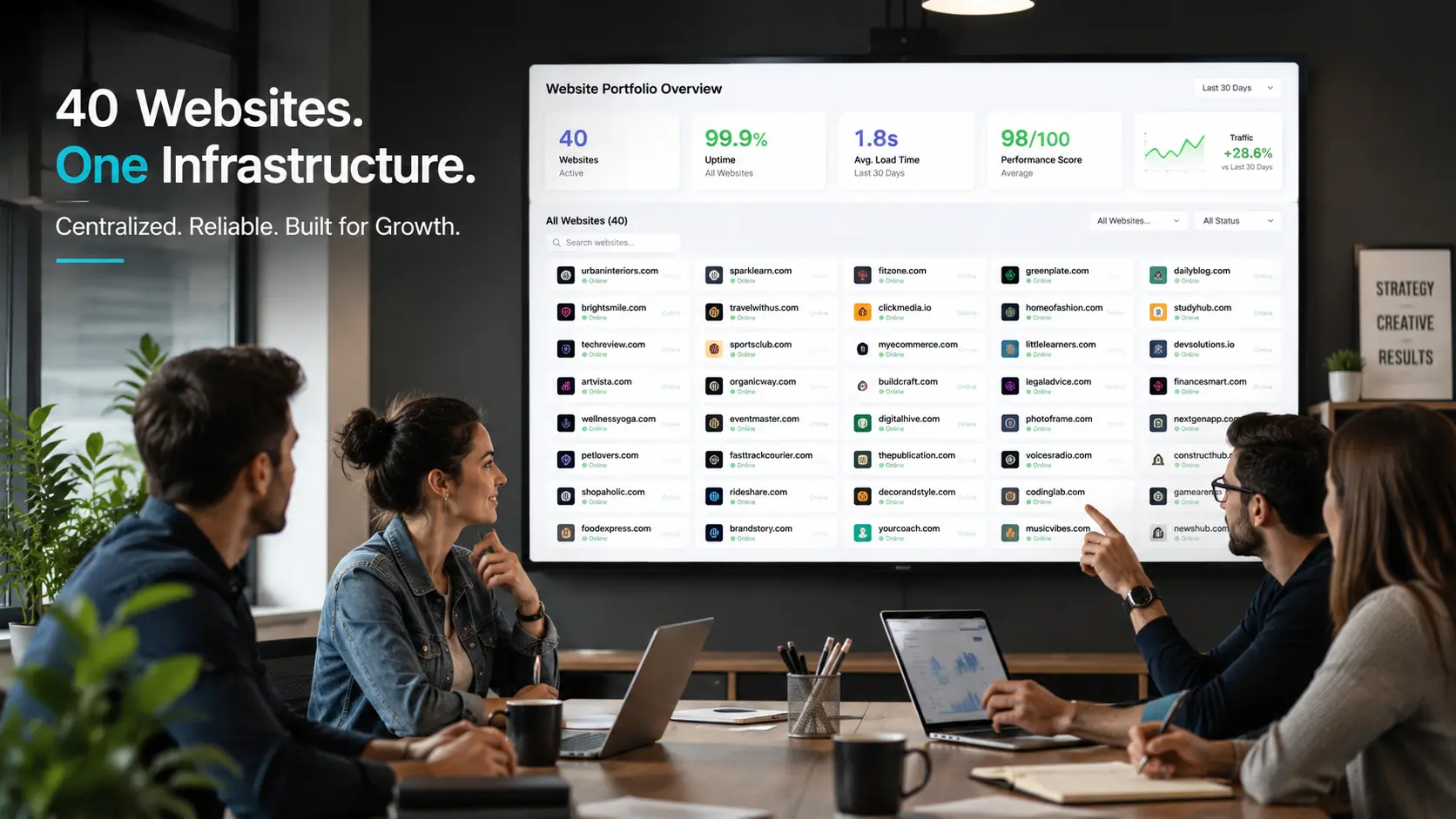
By early 2025, Digital marketing agency managed 40 active client websites across multiple industries, including healthcare, e-commerce, professional services, and education. Over the years, hosting decisions had been made one client at a time. A new project arrived. A hosting recommendation was made. A VPS was provisioned. Another client preferred their existing provider. Another site inherited legacy infrastructure.
The result was a portfolio spread across multiple vendors and environments.
Whenever a performance issue occurred, the team had to determine:
- Which hosting provider the site was using
- Which control panel managed the account
- Which team member originally configured it
- Which support process applied
- Which vendor SLA governed response times
The operational burden was growing every quarter.
A review of internal activity revealed that the agency was spending approximately:
- 36 hours per month diagnosing performance problems
- 18 hours per month communicating with hosting vendors
- 12 hours per month implementing temporary fixes and workarounds
That totaled 66 staff hours every month dedicated to infrastructure-related issues. For an agency focused on growth and client retention, the impact extended beyond operations. Website performance had become a discussion point in eight separate client reviews during a single quarter.
Two clients had informally raised concerns about switching agencies. The estimated annual revenue at risk was approximately ₹6.8 lakh.
“We’d built strong relationships with these clients around their marketing, growth, and business results. Then we’d spend half a QBR explaining why their site loaded slowly on Thursdays. That’s not the conversation we should be having.”
– Account Director, digital marketing agency
The team decided they needed data instead of assumptions.
The Audit
In March 2025, they commissioned a 30-day infrastructure and performance audit across its entire client portfolio. The goal was simple: Understand the problem before choosing a solution.
Audit Findings (March 2025)
| Metric | Snapshot |
|---|---|
| Active client websites | 40 |
| Separate hosting providers | 11 |
| Shared hosting accounts | 18 |
| VPS environments | 7 |
| Different control panels | 4 |
| Total databases | 132 |
| Total managed data | 4.7 TB |
| Active billing cycles | 11 |
| Average page load time | 5.9 sec |
| Sites loading above 6 seconds | 17 |
| Monthly downtime incidents | 9 |
| Hosting-related support tickets | 23/month |
| Client performance complaints | 14/quarter |
| Staff hours spent on infrastructure | 66/month |
The audit revealed something important: The agency wasn’t dealing with a hosting performance problem. It was dealing with infrastructure fragmentation.
Eleven hosting providers meant eleven support teams, eleven renewal schedules, multiple control panels, inconsistent performance standards, and operational complexity spread across dozens of disconnected systems. The question became:
Should they continue improving individual hosting environments, or rethink the entire infrastructure strategy?
Why Upgrading VPS Plans Wasn’t the Answer
The agency’s first instinct was to upgrade the worst-performing VPS hosting environments. On paper, it seemed logical. However, the technical team discovered that upgrading individual servers would only improve performance in isolated cases while leaving the underlying complexity untouched.
They would still be managing:
- Multiple hosting vendors
- Multiple support channels
- Multiple control panels
- Multiple billing cycles
- Multiple infrastructure standards
The performance issue might improve. The operational burden would remain.
After modelling future growth projections, expected client acquisition, and increasing resource demands from healthcare and e-commerce projects, the team concluded that they needed consolidation rather than incremental upgrades.
The requirements were clear:
- Dedicated resources across all client websites
- Predictable performance during traffic spikes
- A single management environment
- One support relationship
- One renewal cycle
- Capacity for future growth without repeated infrastructure decisions
After evaluating options, they chose a dedicated server environment from Ucartz. The objective wasn’t simply better hosting. It was operational simplification.
The Migration Strategy
Because client websites supported active businesses and marketing campaigns, the migration approach focused on minimizing risk. The project was completed over six weeks.
Phase 1: Assessment and Planning
The team mapped every environment before moving any website.
This included:
- Traffic patterns
- Resource utilization
- Database structures
- Backup requirements
- Business-critical periods
- Campaign schedules
Migration windows were planned around client activity to reduce risk.
Phase 2: Migration
Websites were moved in waves, beginning with lower-risk accounts before progressing to larger and more business-critical properties.
Migration outcomes included:
- 40 websites transferred
- 132 databases migrated
- 4.7 TB of data moved
- DNS transitions coordinated through reduced TTL settings
- Data integrity verified after transfer
No critical downtime events occurred during the migration process.
Phase 3: Optimization
After migration, the team optimized the environment by implementing:
- Database query caching
- Resource allocation tuning
- Static asset caching
- Automated daily backups
- Monitoring and alerting thresholds
By the end of the sixth week, all 40 client websites were operating within a single dedicated infrastructure environment.
Results After 120 Days
Four months after migration, they conducted a structured performance review using the same monitoring methodology as the original audit.
Before vs After
| Metric | Before | After | Change |
|---|---|---|---|
| Average page load time | 5.9 sec | 1.4 sec | ↓ 76% |
| Sites loading above 6 sec | 17 | 0 | ↓ 100% |
| Average TTFB | 2.3 sec | 0.19 sec | ↓ 92% |
| WooCommerce checkout load time | 9.1 sec | 1.6 sec | ↓ 82% |
| Unplanned downtime incidents/month | 9 | <1 | ↓ 89% |
| Portfolio uptime | 97.1% | 99.97% | ↑ 2.87pp |
| Hosting-related support tickets | 23/month | 4/month | ↓ 83% |
| Client performance complaints | 14/qtr | 2/qtr | ↓ 86% |
| Staff hours on infrastructure | 66/month | 11/month | ↓ 83% |
| Vendor communication hours | 18/month | 2/month | ↓ 89% |
| Hosting vendors managed | 11 | 1 | ↓ 91% |
| Control panels in use | 4 | 1 | ↓ 75% |
| Client retention rate | 88% | 96% | ↑ 8pp |
| Clients citing hosting in QBRs | 8 | 0 | Eliminated |
| Average cost of emergency site fixes | ₹22,000/event | ₹0 | Eliminated |
| Staff capacity recovered | — | 55 hrs/month | New capacity |
If you want to understand more about metrics, check Google Core Web Vitals Documentation.
How the Improvements Showed Up in Daily Operations
While the performance data showed substantial improvements, the clearest evidence came from day-to-day client interactions. These examples illustrate how the infrastructure changes translated into measurable business outcomes across healthcare, e-commerce, and account management operations.
The Healthcare Client’s Monday Morning Problem
One healthcare client’s patient portal consistently struggled on Monday mornings when reception staff were busiest. Average load times exceeded 8 seconds. The issue had appeared repeatedly during client reviews. After migration, Monday morning load times dropped to approximately 1.2 seconds. Two weeks later, the practice manager sent an unsolicited email noting that the portal finally felt responsive. It was the first positive infrastructure feedback the agency had received from that client in more than a year.
The WooCommerce Promotion That Finally Worked
An e-commerce client had stopped running flash promotions after previous campaigns caused severe slowdowns and lost revenue. Three weeks after migration, the client launched another promotion. Peak concurrent users reached 620. Checkout pages remained responsive at approximately 1.6 seconds. Cart abandonment during the campaign fell dramatically compared with previous promotion periods. The client renewed their retainer agreement two months ahead of schedule.
The QBR That Didn’t Mention Hosting
During the September 2025 quarterly review cycle, the account management team noticed something unusual. No client raised concerns about website performance. For the first time in over a year, discussions focused entirely on lead generation, campaign performance, SEO growth, and future planning.
“It sounds like a small thing, but we’d normalized talking about hosting in client meetings. The moment we stopped, we realized how much time and credibility it had been costing us.”
– Account Director, digital marketing agency
The Financial Impact
The audit revealed that hosting costs extended far beyond monthly invoices. Before consolidation, infrastructure expenses were spread across multiple hidden categories.
Estimated Annual Cost Comparison
| Cost Category | Before | After |
|---|---|---|
| Fragmented hosting environment | ~₹1.24L | — |
| Infrastructure staff time | ~₹4.75L | ~₹0.79L |
| Revenue risk from client churn | ~₹6.8L | ₹0 |
| Dedicated server environment | — | ₹X (verify pricing) |
Estimated Net Impact
- 55 staff hours recovered every month
- Significant reduction in support overhead
- Reduced client churn risk
- Simplified vendor management
- Increased capacity for agency growth
Estimated annual operational benefit: approximately ₹11.2 lakh.
Key Lessons for Agencies Managing Multiple Client Websites
Their experience revealed an important lesson: The trigger for moving to dedicated infrastructure was not traffic volume. It was operational complexity. At 40 websites, the agency was no longer managing hosting. It was managing eleven different hosting ecosystems simultaneously. Each came with its own support process, performance profile, renewal schedule, and operational overhead.
The costs were largely invisible when viewed site-by-site. They became obvious when viewed across the entire portfolio. For agencies managing 15–20 websites or more, the key question may not be whether dedicated infrastructure makes technical sense. The more important question is when infrastructure complexity begins costing more than consolidation.
Where the Agency Is Today
Since completing the migration, they has continued to grow its client base. Every new website is deployed within the same dedicated infrastructure environment. No new hosting vendors. No additional control panels. No repeated infrastructure evaluations.
The 55 staff hours recovered each month have been redirected toward higher-value work, including client reporting, content production, and a long-planned performance benchmarking initiative for all client websites.
Client retention has stabilized at 96%. The two clients who had previously considered switching agencies both renewed. What began as an effort to improve website speed ultimately became an operational transformation.
The biggest benefit was removing infrastructure complexity as a recurring business problem. Managing more than one hosting vendor for your client portfolio? Opt for Ucartz Dedicated Servers which is built for Agency-Scale Workloads.