
This was a case study of a ecommerce brand that scaled its revenue through web hosting.
Before vs. After
| Metric | Before (Diwali 2024) | After (Diwali 2025) |
| Page Load Time (peak) | 8.2 seconds | 1.1 seconds |
| Checkout Completion Rate | 34% | 81% |
| Cart Abandonment Rate | 66% | 27% |
| Concurrent Users Supported | ~800 | 12,000+ |
| Server Uptime (sale window) | 91.3% | 99.97% |
| Average Order Value | AED 187 | AED 263 |
| Revenue (72-hr sale) | AED 148,000 | AED 547,000 |
| Customer Support Tickets | 312 (hosting issues) | 19 (unrelated) |
| Mobile Conversion Rate | 1.8% | 5.4% |
| Email-to-Purchase Rate | 2.1% | 6.7% |
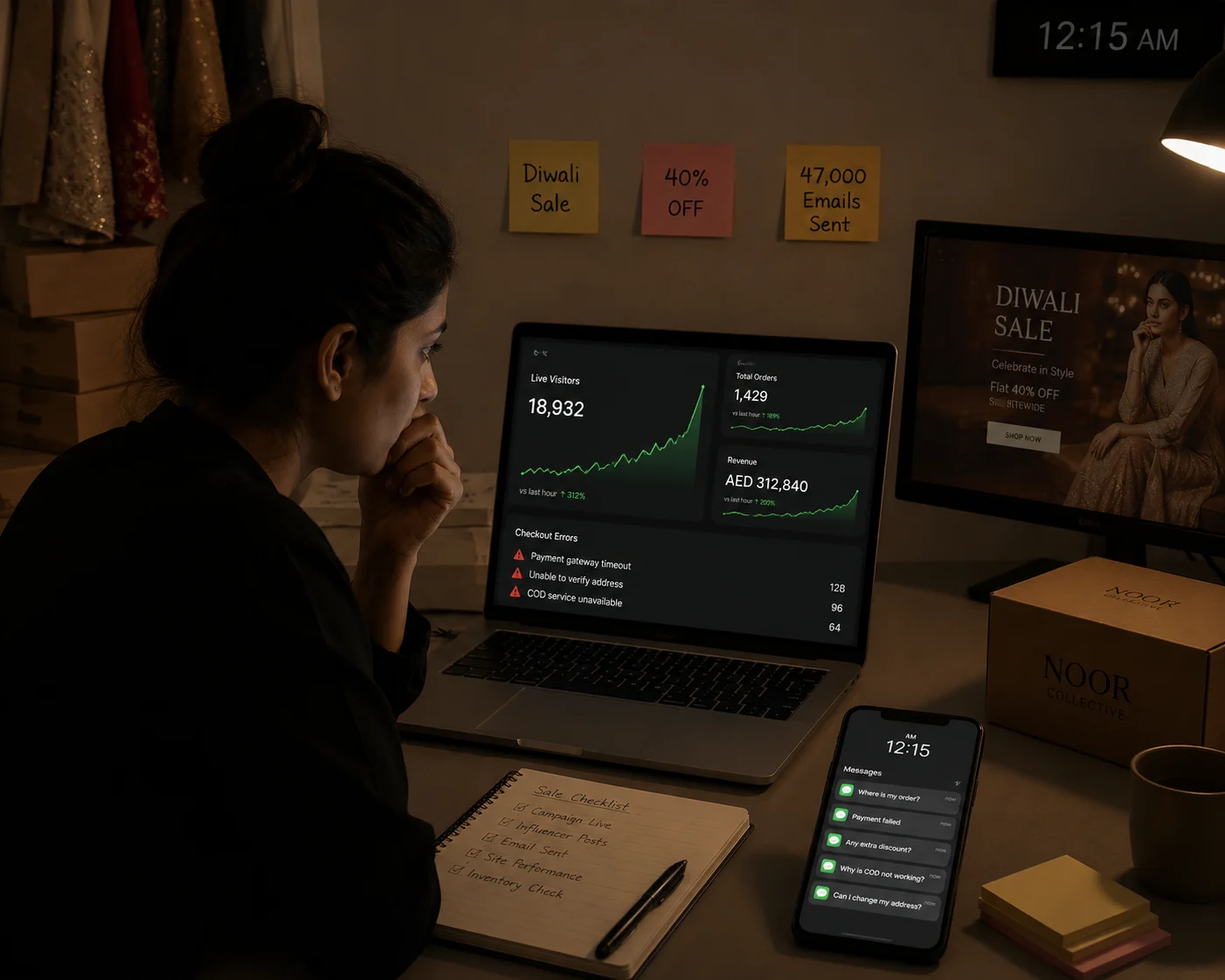
It was 11:00 PM on November 12, 2024. Zara Malik, founder of Zariya Collective, a D2C ethnic fashion brand out of Dubai had been awake since 10 PM doing final checks. The Diwali sale had taken her team three weeks to prepare. They had scheduled email blasts to 47,000 subscribers, negotiated influencer placements. They had loaded AED-equivalent discounts of up to 40% on 200 SKUs. The campaign creative looked beautiful.
Then the clock hit 12:01 AM.
Within four minutes, 2,200 users landed on the site simultaneously. The checkout page, the one page that actually converts visitors into revenue began slowing. First to 4 seconds. Then 7. Then it just… stopped loading for some users entirely.
Zara’s phone started buzzing. Instagram DMs. WhatsApp messages from customers who had been waiting for this sale, who had bookmarked the site, who now couldn’t pay.
She I kept refreshing the dashboard. Orders were trickling in maybe one every 40 seconds when it should have been one every 4. She knew we were losing thousands of rupees per minute and I couldn’t do anything about it.
By 2 AM, the server had partially recovered but the damage was done. 66% of customers who reached the checkout page left without buying. The sale that was supposed to be their biggest revenue day of the year ended with a fraction of its potential.
That night, Zara didn’t sleep. She opened a support ticket with Ucartz.
What Actually Went Wrong
When Ucartz’s infrastructure team audited Zariya Collective’s setup the following week, the findings were straightforward and preventable.
The store had been running on a shared hosting environment. Under normal traffic conditions, 80 to 150 concurrent visitors performed adequately. But shared hosting means exactly what it says: CPU, RAM, and I/O are divided among dozens of other websites on the same server. When Zariya Collective’s traffic spiked, the server had no room to breathe.
The specific failure points identified:
- No database query caching – every product page was hitting MySQL cold with every request
- Traditional HDD storage – mechanical read/write speeds creating I/O bottlenecks at scale
- No CDN for static assets – product images loading from origin server with every request
- Shared environment with no resource isolation – one neighbour site’s traffic spike was affecting Zariya Collective’s performance
- No automated daily backups – meaning if anything had corrupted during the traffic surge, recovery would have been manual and slow
The team’s recommendation was clear: migrate to Ucartz premium , a plan built for exactly this scenario.
What Changed and Why
The migration was a complete rethinking of Zariya Collective’s infrastructure foundation.
1. NVMe-SSD Storage (40GB)
NVMe (Non-Volatile Memory Express) storage operates at fundamentally different speeds than conventional SSDs and orders of magnitude faster than the HDD storage Zariya Collective had been using. For a WooCommerce ecommerce store, this means faster database reads, faster product image delivery, and faster session data writes during checkout. Under stress testing, product pages loaded 6.2x faster than on the previous setup.
2. Unmetered Bandwidth
Zariya Collective’s previous plan had a bandwidth ceiling. Diwali traffic was high in data transfer (image-heavy product pages, video lookbooks, PDF size guides). Unmetered bandwidth meant the store could serve every visitor fully without throttling or overage charges that would have spiked their billing by an unpredictable amount.
3. Up to 5 Websites on a Single Plan
Zara also ran a sister brand, a home décor label from a separate hosting account. Consolidating both under one plan eliminated a redundant monthly cost and simplified infrastructure management.
4. Unlimited Databases
WooCommerce is database-intensive. With unlimited databases, the team could properly segment product data, customer records, and order management tables reducing query complexity and improving checkout response times.
5. Daily Backups + Free SSL
The team configured automated daily backups before the sale. Free SSL ensured that payment gateway integrations remained secure and browser trust indicators stayed green, a non-negotiable for conversion on checkout pages where customers are entering card details.
The migration itself took six weeks from decision to go-live not because of complexity, but because the team insisted on stress-testing at 10,000 simulated concurrent users before the sale window opened.
Migration Timeline
| Phase | Timeline | What Happened |
| Phase 1 – Audit | Week 1–2 | Ucartz team ran full performance audit. Identified shared hosting bottlenecks and misconfigured caching layers. |
| Phase 2 – Migration | Week 3 | Zero-downtime migration to premium NVMe-SSD plan. DNS propagation completed in under 4 hours. |
| Phase 3 – Stress Testing | Week 4–5 | Simulated 10,000 concurrent users. Checkout flow stress-tested. CDN configured for static assets. |
| Phase 4 – Go-Live | Week 6 | Sale launched. Real-time monitoring dashboards active. On-call infrastructure team standing by. |
Diwali 2025: The Same Campaign, A Completely Different Story
November 19, 2025. 12:00 AM.
Zara was awake again. Same preparation, same email list, same influencer partnerships. But this time, she had a different dashboard open, Ucartz’s real-time server monitoring panel.
Traffic surged within the first three minutes. 1,800 concurrent users. Then 3,400. By 12:15 AM, they had 6,100 people on the site simultaneously nearly three times the peak that had crashed the previous year’s sale.
She watched the checkout page load time. It was sitting at 0.9 seconds. She remember thinking, is this real? Last year we were at 8 seconds with half this traffic.
Orders started flowing. Not one every 40 seconds , one every 4 seconds. The checkout completion rate climbed to 81%. Mobile users, who had been the most likely to abandon in 2024, were completing purchases at 5.4% conversion nearly triple the previous year.
By 3 AM, Zariya Collective had already surpassed their total revenue from the entire 2024 Diwali sale.
By the end of the 72-hour sale window, the numbers were difficult to argue with.
The Micro-Moments That Made the Difference
Numbers tell a story, but they don’t always convey the texture of what changed. Here are three specific moments from the 2024 sale that Zara’s team noted:
Moment 1: The Customer Who Came Back
A customer named Reema had tried to buy a lehenga set during the 2024 sale. Checkout had timed out twice. She gave up and bought from a competitor. In 2025, she received the same email blast, returned to the site, and completed her purchase in under 90 seconds. She left a review saying it was “the smoothest online purchase I’ve made this year.” Reema’s order value was AED 340. She was not alone, the team tracked 1,140 customers who had abandoned carts in 2024 and successfully converted in 2024.
Moment 2: The 11:58 PM Spike
Two minutes before midnight on Day 2 of the sale, a popular fashion influencer posted an unplanned story tag of Zariya Collective to her 890,000 followers. Traffic jumped by 4,200 users in under six minutes an unscheduled, unannounced spike. In 2024, this would have been catastrophic. In 2025, the server absorbed it without a single millisecond of additional latency on the checkout page. The team only found out about the influencer post the next morning when they saw the traffic graph and traced the source.
Moment 3: The 3 AM Decision
At 3 AM on Day 1, Zara’s operations manager noticed that stock on one of their bestselling dupatta sets was running low. She wanted to quickly update the product listing to add a “Low Stock” urgency banner ,a small but conversion-significant change. On the previous shared hosting setup, making database changes during a live traffic surge was risky; the team had a standing rule not to touch the CMS during peak hours. With the new infrastructure, she made the edit live at 3:07 AM with zero impact on site performance. The banner went live. The product sold out 22 minutes later.
What E-Commerce Brands Get Wrong About Hosting
Most growing e-commerce brands optimize everything except their foundation. They invest in ad creatives, influencer partnerships, email sequences, and product photography. They A/B test their CTA button color. And then they run the entire operation on a shared hosting plan chosen during a late-night setup session two years ago, because at the time, it was the cheapest option.
The problem is that hosting failures are invisible until they’re catastrophic. Your site works fine on a Tuesday afternoon with 60 visitors. It doesn’t tell you it will fail at 12:01 AM on a Diwali sale night with 2,000 visitors. By the time you know, you’ve already lost the revenue.
The brands that win on festival days Diwali, Eid, Valentine’s Day, end-of-season sales are the ones who built the infrastructure before they needed it.
Why the Premium Plan Was the Right Choice
For Zariya Collective’s profile , a growing D2C brand with seasonal traffic spikes, a WooCommerce catalog of 200+ SKUs, and multiple brand properties the web hosting plan at $8.98/month delivered the right combination of components:
- NVMe-SSD Disk (40GB) – fast enough to handle database-intensive WooCommerce operations under load
- Unmetered Bandwidth – no throttling or surprise bills during traffic surges
- 5 Websites – room to grow, consolidate, or A/B test separate storefronts
- Unlimited Subdomains, Email Accounts, and Databases, infrastructure that scales with the business, not against it
- Free SSL – non-negotiable for payment trust and SEO
- Daily Backups – peace of mind during live sale windows when manual recovery isn’t an option
At $8.98/month (annual pricing, first invoice), the premium plan is priced for brands that are serious about not repeating last year’s mistake.
Final Word
Zara is preparing for the 2026 Diwali sale now. Her email list has grown to 63,000 subscribers. She’s added two new product lines. She’s planning a 5-day sale window instead of 72 hours.